AU
  
You are currently viewing the Australia version of the site.
Would you like to switch to your local site?
4 MIN READ TIME

New climbing method observed in invasive tree snake
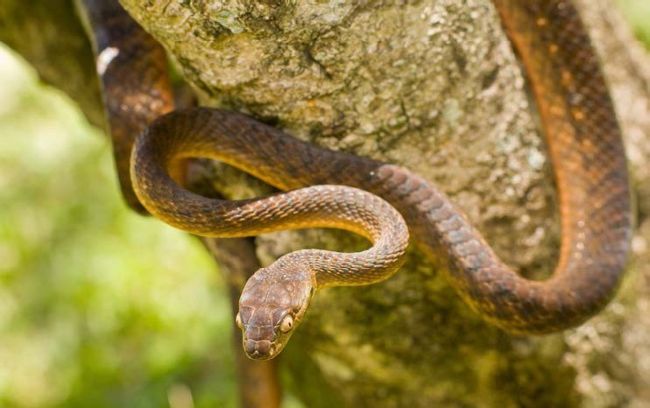
A brown tree snake – as its name suggests, this species can climb well.
Photo courtesy Janelle Lugge/www.shutterstock.com

Researchers have discovered that invasive brown tree snakes (Boiga irregularis) living on the Pacific island of Guam can get around in a way that had never been seen before. The discovery of the snake’s lasso-like locomotion for climbing their way up smooth vertical cylinders has important implications, both for understanding the snakes and for conservation practices aimed at protecting birds from them.

“Our most important finding is a new mode of snake locomotion,” says Julie Savidge of Colorado State University (CSU). “Only four major types have been recognised for nearly 100 years, and we now have discovered a fifth mode.”

The discovery of this new method of locomotion – in additional to the known rectilinear, lateral undulation, sidewinding, and concertina modes – came about by chance. Savidge was working on a project aimed at protecting the nests of Micronesia starlings, which represent one of only two native forest bird species still remaining on Guam.

Read the complete article and many more in this issue of Practical Reptile Keeping
Purchase options below
If you own the issue, Login to read the full article now.
Single Digital Issue January 2021
 
$6.99 / issue
This issue and other back issues are not included in a new subscription. Subscriptions include the latest regular issue and new issues released during your subscription. Practical Reptile Keeping
Annual Digital Subscription $51.99 billed annually
Save
38%
$4.33 / issue
6 Month Digital Subscription $27.99 billed twice a year
Save
33%
$4.67 / issue
PRINT SUBSCRIPTION? Available at magazine.co.uk, the best magazine subscription offers online.
 

This article is from...


View Issues
Practical Reptile Keeping
January 2021
VIEW IN STORE

Other Articles in this Issue


Practical Reptile Keeping
Welcome
It’s great to be able to find good news to report at
Regulars
New hope for previously doomed turtle species
Featuring stories about the strange way in which a new type of snake was discovered, how a conservation programme to reintroduce geckos has thrown up unexpected results, an unusual finding about the way that a snake has adapted its method of moving, why crocodiles have remained largely unchanged in appearance for millions of years, and more, starting with fantastic news for one of the world’s most critically-endangered species, which was feared to be heading to extinction.
Why crocs have not changed a lot
New research by scientists at the University of Bristol
The strange discovery of a remarkable new species of snake
In all honesty, the newly-described Waray dwarf burrowing
How to help geckos adapt to a new area
University of Otago researchers have added another
Owls help to identify rare invertebrates
The feeding habits of birds can be an invaluable tool
Giant prehistoric crocodile discovered
A prehistoric crocodile measuring more than 5m (16.5ft)
HOW FLYING REPTILES EVOLVED
Pterosaurs were the earliest vertebrates to develop
Puzzle Corner
Find the solutions to these puzzles by following the clues, to discover which reptiles, amphibians or invertebrates are hidden within them. The answers can be found on p66.
How amphibians see the world
Continuing his series about amphibians and their biology, Paul Donovan concentrates on their sense of sight. Good vision is obviously important with regard to many aspects of an amphibian’s lifestyle, ranging from recognising a potential threat to spotting prey, but how does it compare with that of other animals, and particularly reptiles?
Turtle tank set-up & lighting
Email your queries to practicalreptilekeeping@gmail.com.
Size is no indicator of aggression
I recently acquired three electric blue geckos - a
REPTILE FOCUS
This species is widely-distributed across sub-Saharan
TALES OF GIANTS
Dr Karl Shuker examines the evidence surrounding the descriptions of two ancient giant creatures mentioned in the Bible, and considers if their identities can now be accurately determined and whether they are reptiles?
YOU & YOUR Reptiles
If you have a favourite photograph of one of your reptiles
SUBSCRIBE ONLINE TODAY!
. Next issue.
Don’t miss our exclusive interview with the scientist
Features
New diagnostic techniques
There are a number of additional ways in which sick reptiles can now be assessed, as explained by Dr Joanna Hedley, BVM&S, DZooMed (Reptilian), DECZM (Herpetology), MRCVS.
New thoughts on old problems
As a reptile vet, there are a number of so-called “common
ANISOMORPHA – a real stinker!
Edward Baker considers some stick insects with a very effective means of defending themselves from would-be predators. These are not recommended as children’s pets!
How to look after and breed Bismarck pythons
Remember the story about the ugly duckling? Well, picture it in reverse, removing the bird and water, and substitute a snake and a group of islands. Meet the Bismarck python. Christian Castille provides a definitive account of these snakes.
Keeping and breeding green tree monitors
Ever since the first wild-caught specimens began to appear in high-profile zoological collections about 20 years ago, the green or emerald tree monitor (Varanus prasinus) has captivated the herpetological community but it has remained rare. Just recently however, thanks to an increasing understanding of its needs, so a few successful breedings are starting to occur regularly, with small numbers of captive-bred youngsters now becoming available. Hannah Salisbury recounts her experiences with this colourful species.
Chat
X
Pocketmags Support