THE MAKING OF Wizardry
PROVING GROUNDS OF THE MAD OVERLORD
THE CREATORS OF THE INFLUENTIAL 1981 RPG – WHICH WENT ON TO INSPIRE COUNTLESS TITLES, FROM DRAGON QUEST TO FINAL FANTASY – EXPLAIN HOW IT HAD ITS ORIGIN IN SOME OF THE EARLIEST ONLINE EXPERIENCES, AND WAS ONE OF THE FIRST COMPUTER GAMES TO COME IN A BOX
WORDS BY LEWIS PACKWOOD
IN THE KNOW
» PUBLISHER: SIR-TECH
» DEVELOPER: SIR-TECH
» PLATFORM: APPLE II, DOS, FM-7, PC-98, MAC, PC-88, SHARP X1, MSX, COMMODORE 64/128, NES, GAME BOY COLOR, WONDERSWAN COLOR, NINTENDO SWITCH
» RELEASED: 1981
» GENRE: RPG
DEVELOPER HIGHLIGHTS
GALACTIC ATTACK (PICTURED)
PLATFORM: APPLE II RELEASED: 1980 STAR MAZE PLATFORM: APPLE II, COMMODORE 64, ATARI 8-BIT
RELEASED: 1982
WIZARDRY II: THE KNIGHT OF DIAMONDS PLATFORM: APPLE II, FM-7, PC-98, PC-88, SHARP X1, DOS, COMMODORE 64/128, MSX, MAC, NES, GAME BOY COLOR
RELEASED: 1982
Few games have been as influential as
Wizardry: Proving Grounds Of The Mad Overlord.
Even if you haven’t played it, you will have undoubtedly played games that were inspired by it. Indeed, after discovering the game during a trip to Apple Fest in San Francisco in 1983, Koichi Nakamura and Yuji Horii used
Wizardry’s
battles as the basis for
Dragon Quest,
mixing them with the overhead perspective of
Ultima.
Yuji has even said that
Dragon Quest’s
ubiquitous Slimes were directly inspired by the slime monsters in
Wizardry.
Along with Richard Garriott’s Ultima, which was released for the Apple II at almost the same time in 1981, Wizardry has been credited with popularising computer RPGs, bringing them to a wide audience for the first time, and setting the template for others to follow. But Wizardry itself was inspired by earlier RPGs. “I was a huge D&D player, and also I was very heavily influenced by some really great games on the PLATO system that I had access to at college,” says Robert Woodhead, co-creator of Wizardry. PLATO was a pioneering networked computer system that was home to some of the earliest online games. It was “at least ten years ahead of its time, if not twenty,” Robert says. “Basically, everything you love about the internet and computer games was beta tested on PLATO.”
One title that had a big influence on Wizardry was the multiplayer dungeon crawler Oubliette (1977). In fact, Robert was so obsessed with Oubliette and other Dungeons & Dragons-inspired PLATO games that he was suspended from Cornell University for spending too much time playing them. It was during this “enforced sabbatical”, as he describes it, that he met Norman Sirotek. Norman’s father and Robert’s mother had a joint venture involving resin-sand moulds, and they brought in Robert to create an Apple II program for calculating railshipping rates. Norman drove Robert out to the Trenton Computer Festival to show off the program in 1979, and on the drive back, Sirotech Software was born. “I said, ‘Look, you want to make games, I know more about business than you do, so why don’t we form an entity?’” Norman recalls. “‘You make it, I sell it.’”
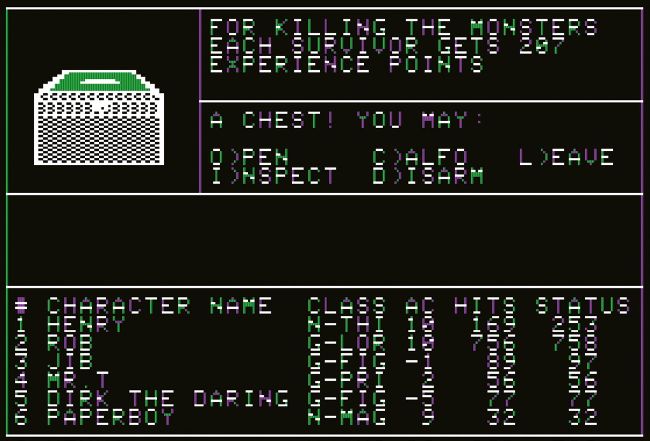
» [Apple II] Adventurers should be wary of opening chests: some of them are secured by traps that need to be disarmed.
Sirotech released the Apple II space combat simulator Galactic Attack in 1980, after which the firm became Sir-Tech to sever the link with the Sirotek family name. “We kept getting phone calls at home, people looking for hints and guides and all the rest of it to play the games,” says Norman. “At 3am, you can only take so many of those phone calls, so we said, ‘Look, why don’t we drop the ‘o’ and insert a hyphen?’”