ROAD TEST 5732
RENAULT 5
Hotly anticipated EV is already Car of the Year. Now for the real test
MODEL TESTED
RENAULT 5 COMFORT RANGE ICONIC FIVE
Price £28,995
Power 148bhp Torque 181lb ft 0-60mph 7.7sec 30-70mph 7.2sec Top speed 94mph (claimed) 70-0mph 44.4m (5deg C, dry) Range 166/161/260 miles (average/touring/everyday) Economy 3.2/3.1/5.0mpkWh (average/touring/everyday) Weighted average charging rate 71kW
Insome ways it feels like we know the new, reimagined Renault 5 very well already.
It’s been four years since the bigwheeled, boldly styled concept car blasted a splash of yellow across our screens. Rather than quietly retreat to Renault’s heritage collection, the concept was developed into a production car that looks just as spectacular. And it’s not a mere small-series vanity project. The new 5 is here to be Renault’s mainstream hatchback, an entry point into its EV line-up. With a headline price of £22,995, it’s no more expensive than a mid-spec hybrid Clio.
The 5 has already won a number of awards – not least Car of the Year. Can it add five stars from Autocar to its achievements? We’ve got a highspec long-range car to find out.
DESIGN &ENGINEERING
★★★★★
PROS Eye-catching looks; produced in Europe; competitive battery size; multi-link rear suspension CONS None
Some cars are all about the engineering, and while the 5 is a lot more than just a pretty face, it’s the pretty face that’s grabbing all the headlines. The story goes that when Luca de Meo became CEO of the Renault Group in 2021, he surveyed the design studio to get a handle on the new models already coming down the pipeline and found mostly worthy but uninspiring stuff.
Strategically ‘left sitting around’ was a styling model of a car that looked remarkably like a reinterpretation of the old 5. It was meant to be just a style exercise by designer François Leboine (who has since joined Fiat and Abarth) that wasn’t destined for reality because it was too retro. However, de Meo reckoned this had to be Renault’s future direction, so engineering was tasked with bringing it to life.
This was turned first into the 5 concept car that was presented at the start of 2021. Back then, a 2023 release date for the production car was mooted, but it has clearly taken a bit longer. Nevertheless, the design of that original concept has been largely maintained. The production car doesn’t stray too far from those lines, and keeps the short overhangs, big wheels and features characteristic of the 5. By and large, it was a case of fitting the mechanicals – some new, some off the shelf – under this new design.
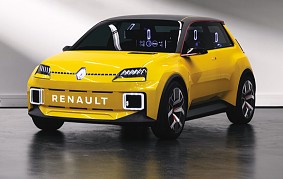
Production car is faithful to 2021 concept
In 2022, Renault hived off its EV and software activities into Ampere, a dedicated new business parallel to its combustion-engine joint venture with Geely called Horse. One of Ampere’s tasks was to develop an architecture fit for Renault’s new electric plans, and the result is the Ampr Small platform, which will also underpin the upcoming Renault 4 and Twingo.
Renault says there are minimal similarities and shared parts or software with the CMF platform, which, unlike Ampr, does double duty for both electric and combustion-engined models.
However, it is still modular, so that existing components could be repurposed where appropriate. As such, the 5 uses a combination of the familiar and the new. For instance, the front-axle assembly is from the Clio and Captur, and the rear multi-link axle was adapted from the four-wheel-drive version of the Dacia Duster. The latter was chosen because in such a small car the trailing arms of the more common torsion beam axle would intrude into the space for the battery pack. Of course, it also brings ride and handling benefits and puts it on an equal footing with the Mini Cooper E.
The battery itself, despite being available with the same two capacities as the old Zoe (40kWh and 52kWh), is rather different. For one, it is now liquid-cooled (like in most modern EVs) rather than just air-cooled, to ensure it maintains its performance in a wider range of conditions, and is up to being DC rapid-charged at up to 90kW for the small version and 100kW for the larger one. It also has a very different configuration, with fewer separate modules and more cells to a module.