RANGE ROVER ELECTRIC
Britain’s benchmark luxury off-roader makes the bold leap to battery power. We get a first taste in prototype form
TESTED 26.6.25, HEREFORDSHIRE DELIVERIES AUTUMN
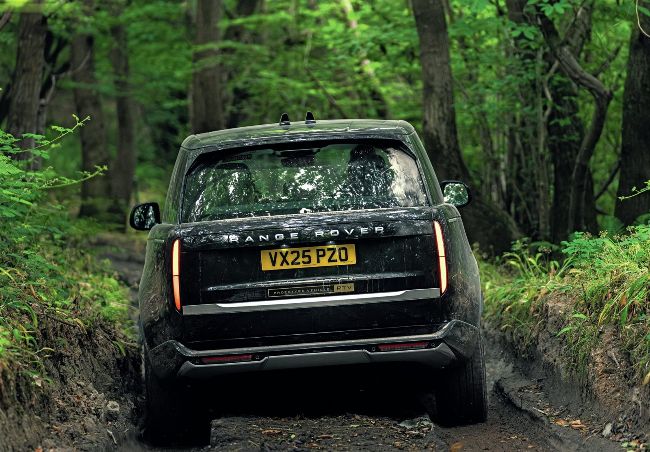
Electric drive allows a finer, faster apportioning of power when off road
TESTER’S NOTE
The 3.5-tonne towing capacity of the standard car will drop to 2.5 tonnes in the EV. JLR has also developed special software to effectively estimate electric range when towing – which will take a hefty turn.
MS
Right now, 2.8 tonnes of high-end automotive real estate is gently picking and clambering its way up a dusty, rocky forest track. It’s doing so in a part of rural Herefordshire where for decades its various predecessors have been brought to earn their stripes as one of the most celebrated lineages in British car-making has advanced: that of the Range Rover. We are at JLR’s Eastnor off-road development and demonstration centre, and we have come for our very first taste of arguably the boldest full-sized Rangie there has yet been.
The Range Rover Electric is JLR’s first EV since the Jaguar I-Pace of 2018. It will be introduced to the global market later this year, at a time of uncertainty for the wider adoption of electric cars. And yet there’s an equanimity about this car’s execution, along with an authenticity about its identity, that suggests it will do all right whichever way the wind of public opinion happens to be blowing. That’s because rather than appearing as a novelty item, this car derives its strength from being just another Range Rover. It won’t replace or supplant any other Range Rover derivative; nobody will be obliged, cajoled or persuaded to buy one. It’s an extension of the Range Rover model line, to sit alongside the various petrol, diesel and PHEV derivatives that already exist, and it is designed to be every inch as capable, luxurious, enveloping and special as any of them.