ROAD TEST 5761
RENAULT 4
Utility appeal refashioned for a new age taps EV tech from a class leader
MODEL TESTED
RENAULT 4 E-TECH COMFORT RANGE ICONIC
Price £30,995
Power 148bhp
Torque 181lb ft
0-60mph 8.6sec
30-70mph 7.5sec
70-0mph 48.3m (23deg C, dry)
Top speed 93mph (claimed)
Range 182/172/291 miles (average/touring/everyday)
Economy 3.5/3.3/5.6mpkWh (average/touring/everyday)
Weighted average charging rate 74kW
Renault’s daring decision to reinvent the famous 5 and bust one of car design’s fundamental rules – ‘never regurgitate your history’ – appears to have been a masterstroke. The new, all-electric 5 oozes character inside and out, it handles smartly and it is ultra-competitive on cost. It’s now the clear leader in a congested class.
The strategists at Renault’s HQ in Boulogne-Billancourt will be doubly delighted because they’ve had the chance to repeat the trick with another back-catalogue icon: the 4.
You’ll know the source material. More than eight million 4s were sold between 1961 and 1994, with production in places ranging from Wexford in Ireland to Antananarivo in Madagascar where, brilliantly, the little French station wagon remains the taxi du jour.
Where the original 5 was more about fun, the 4 was about practicality. It offered surprisingly good ride comfort on France’s war-torn country roads, as well as total utility. The need to maximise interior space is why the original 4 has a different wheelbase on each side; one of the semi-trailing arms on the rear suspension is mounted just ahead of the other, to prevent the mechanicals encroaching on cabin space. For the same reason, the gearbox is mounted directly ahead of the engine: no awkward transmission tunnel. The big boot opening also extends to the very base of the bumper.
The reinvented 4 isn’t quite so extreme in its pursuit of utility, and doesn’t quite match the original’s 22cm or so of fairly unregulated suspension travel (neither, frankly, would we want it to). Nor, at £27k or more, does it quite have rock-bottom pricing. (If anything, the 4’s true modern counterpart is the Dacia Duster.) But it does recapture to a fair extent the philosophy of its progenitor and is meaningfully different from the new 5, with which it shares a platform and nearly everything else. Is it similarly lovable? Let’s find out.
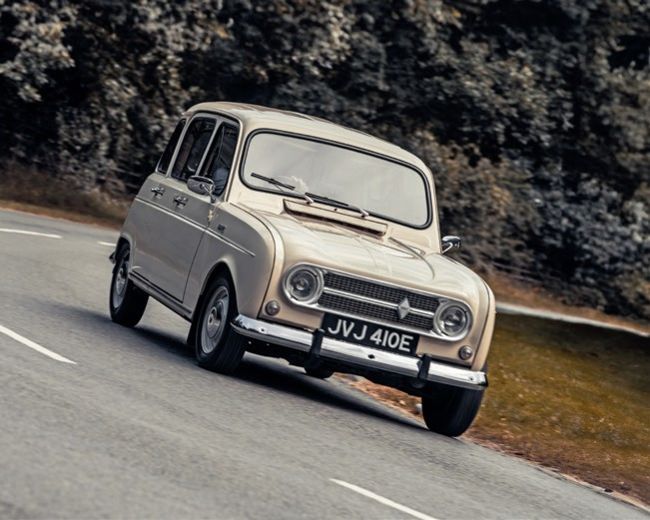
Renault sold more than eight million 4s
PHOTOGRAPHY JOHN BRADSHAW
DESIGN & ENGINEERING
★★★★✩
PROS Charismatic looks; grown-up suspension; reasonably light
CONS No 4WD version, yet
In its positioning, the 4 is to the 5 what the Captur is to the Clio. At 4144mm, the newer car is 222mm longer than the 5 (but not any wider), with 84mm of that difference found in the wheelbase and plenty of the remainder in the rear overhang, with its chunky bumper and characteristically forward-leaning tailgate.
The two-box silhouette is of course now crossover-flavoured, with a propped-up ride height enhanced by tyres with a slightly greater profile than those on the 5, but it is unmistakably 4. Throwback details come in the form of circular headlights within an LED-rimmed, one-piece grille that references the original’s aluminium surround, introduced in 1967, and ridges along the flanks, which were introduced a little later. The rear quarterlight window is another reference to the original 4, as are the neat, lens-less tail-lights.