Bentley Continental GT
Range-topping two-door gains trick tech upgrades and heads off to hunt Astons
ROAD TEST
No 5554
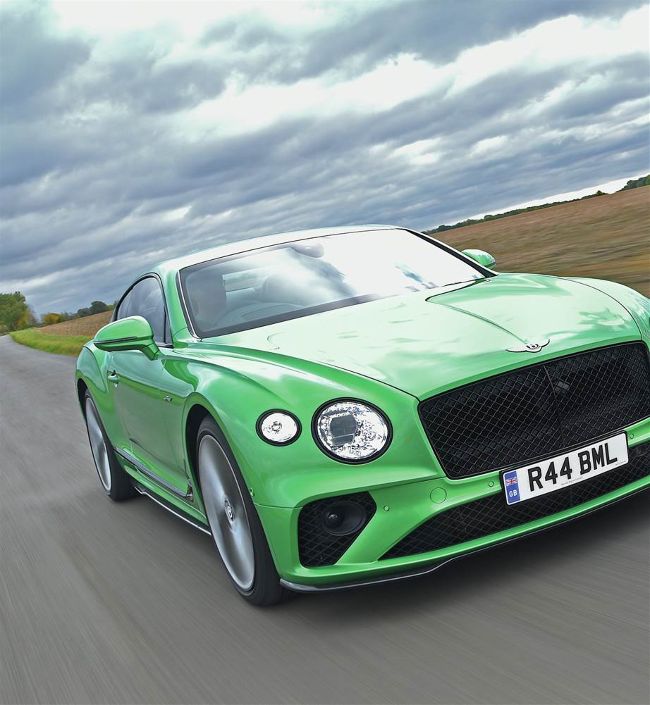
PHOTOGRAPHY WILL WILLIAMS
MODEL TESTED SPEED
COUPE Price £209,900 Power 650bhp Torque 664lb ft 0-60mph 3.4sec 30-70mph in fourth 4.9sec Fuel economy 16.6mpg CO 2 emissions 311g/km 70-0mph 45.5m
We like
• Does big outright pace with luxury-level silken smoothness
• Handling is better balanced and more adjustable than that of any other Bentley
• Remains an uncompromising and opulent luxury operator
We don’t like
• W12 engine has only qualified performance appeal
• Long cruising legs blunt performance a little in higher gears
• Considerable weight and the tuning of the active systems take an edge off its driver appeal
T he clock is ticking for brands that make big, expensive, combustionengined luxury cars like Bentley’s new Continental GT Speed. Long-stated government policy and associated legislation will allow them to continue to sell their petrol-fuelled wares, but public opinion, and the buying behaviour it inf luences, is a moving target. Depending largely on which zero-emission alternatives arrive, big-emitting fossil-fuelled luxury sports cars may become very hard to sell in key markets well before the UK’s 2030 ban on combustionengined cars comes into force.
It helps explain why we’re seeing this Speed performance version of the Continental GT just three years into the third-generation model’s life cycle, when we didn’t see the equivalent in previous generations until years later on. But that time pressure, assuming it was a factor, hasn’t turned this range-topping GT into a rushed effort: the GT Speed adopts chassis technologies never before seen on a production Bentley. Although slightly less potent than the end-of-the-line, last-generation GT Supersports, it’s lighter than that car, has bigger wheels and brakes, features more specialised driveline technology and, Bentley claims, is just 0.1sec slower from rest to 62mph.
Rather than as some super-luxury Porsche GT-car rival, though, the new GT Speed is positioned simply as the world’s best two-door luxury GT: a car that brooks no compromise on opulent comfort, refinement or usability, but one that takes the GT to new heights for pace, handling dynamism and driver reward. Can that be believed? Stand by to find out.
DESIGN AND ENGINEERING
★★★★☆
Sticking with the Volkswagen Group’s MSB platform, the GT Speed carries over the same three-chamber, adaptively damped air suspension as the regular GT and the same eightspeed dual-clutch automatic gearbox and electronically controlled active four-wheel drive system, all of which run recalibrated software to deliver a more sporting focus. It has the Bentley Dynamic Ride 48V active anti-roll bars that come as an option on lesser GTs, but they run with even more extensively retuned settings.
Those clever anti-roll bars need to work even more cleverly because, unlike any other GT to date, the GT Speed also features a four-wheel steering system adapted from that of the Flying Spur. It works via a secondary steering rack acting on the tie rods of the multi-link rear axle, but its tuning is very different here. The system not only aids manoeuvrability at low speeds by shortening the car’s effective wheelbase, but it also moves the GT’s centre of yaw forward and away from the rear axle, allowing the chassis to pivot much closer to its middle when cornering. The fourwheel steering system’s effectiveness, Bentley says, is as much to do with the aggressiveness with which it turns those rear wheels as it is the angle to which it turns them.
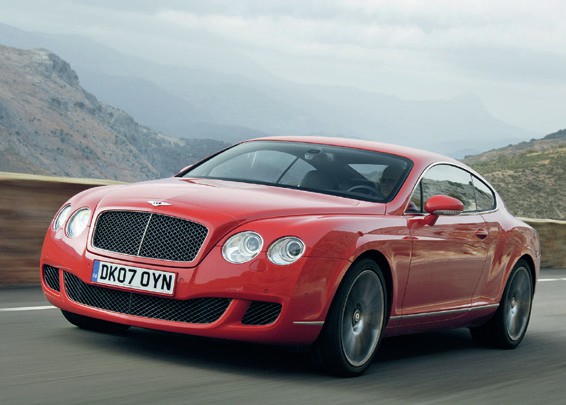
Previous GT Speeds had a similar formula
Range at a glance
TRANSMISSIONS
8-spd dual-clutch automatic
The introduction of the new GT Speed spells the end of the regular W12-engined GT, which keeps the two-door Continental derivative line from swelling too much. The Mulliner Edition cars, meanwhile, build on the Continental’s luxury ambience with special design details and materials. As is now familiar, Bentley’s optional ‘Specification’ packages (Mulliner Driving, Touring, Styling, Continental Blackline etc) become key de-facto trim levels, which are likely to affect the residual values of your car, so some are worth having.