Renault Scenic E-Tech
The once genre-defining family car reinvents itself for the EV era
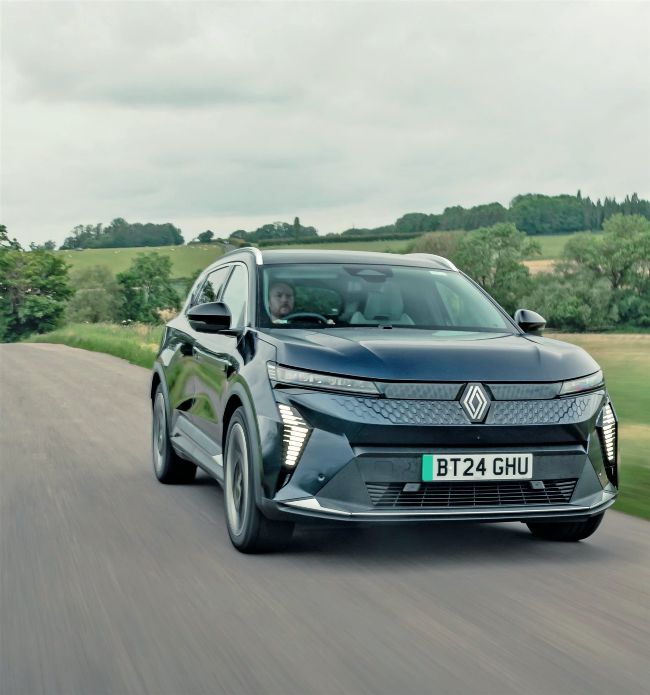
PHOTOGRAPHY JOHN BRADSHAW AND MAX EDLESTON
MODEL TESTED ICONIC LONG RANGE
Price £45,440 Power 215bhp Torque 221lb ft 0-60mph 8.1sec 30-70mph 6.3sec Economy 3.6mpkWh DC Max charging speed 144kW 70-0mph 46.9m
We like
• Efficient driveline combines with a big battery for excellent range
• Good looking inside and out, with a kerb appeal that’s rare in this class
• Impressive infotainment array, with neatly integrated Google Maps
We don’t like
• Forward visibility is curiously poor for an out-and-out family car
• Performance and ride quality are merely so-so
We’ll delve into the various strengths,weaknesses and quirks of the new Renault Scenic in just a moment, but perhaps the biggest story here is one comprehended merely by looking at the car.
You’ll notice that the fifth-generation Scenic on test here has a two-box design in the crossover style that’s now completely commonplace. This marks a seismic change in the Scenic philosophy, which for the previous four generations had been expressed with a one-box silhouette that the French call ‘monospace’. The earliest Scenic of the mid-1990s was the brainchild of Renault’s visionary chief designer, Patrick Le Quement, and was the original sensibly sized MPV. It was regarded at the time as a revelation in packaging and usability, and the fact that the Scenic has now fallen into line with everything else in terms of its packaging really does represent the final nail in the MPV coffin. Thrusting SUV-type cars are what sells these days.
But even switching to a two-box design – even one as handsome as this new Scenic undeniably is – doesn’t guarantee success. The other big twist in the Scenic’s story is that the car is now solely electricpowered, and operating in the circa-£40,000, mid-size crossover EV sphere brings with it almost endless competition. This new Renault goes up against the Skoda Enyaq, Tesla’s Model Y, the Volkswagen ID 4, Peugeot’s new e-3008, the Hyundai Kona EV and lower-spec versions of Hyundai’s Ioniq 5, as well as its mechanically related cousin, the Nissan Ariya. Compared with the original of 1996, this Scenic could hardly be less niche-busting.
Renault would argue that it doesn’t need to be. The new car’s sharp exterior design, plus an interesting interior that makes laudable use of recycled materials, along with strong on-paper driving range and adequate performance, will make it the natural choice for many buyers, according to the French car maker. What we will now find out is whether that really is the case.
DESIGN AND ENGINEERING
The Scenic E-Tech is underpinned by the same modular CMF-EV architecture that you will find beneath the smaller Mégane E-Tech hatchback and the similarly sized Nissan Ariya. Renault’s latest crossover is, in many ways, simply an enlarged version of the Mégane, with 100mm inserted into the wheelbase and 70mm or so of additional height. The Scenic is not all that big, mind: its roofline sits lower than that of even a Volkswagen ID 3, while its overall length is among the shortest in the segment. That may well appeal to urban-centric owners.