FORD CAPRI EXTENDED TEST
Nostalgia vs reality
Is it really feasible to get a classic car and use it as your everyday motor in 2023? Steve Cropley gives it a go with a 1977 Ford Capri
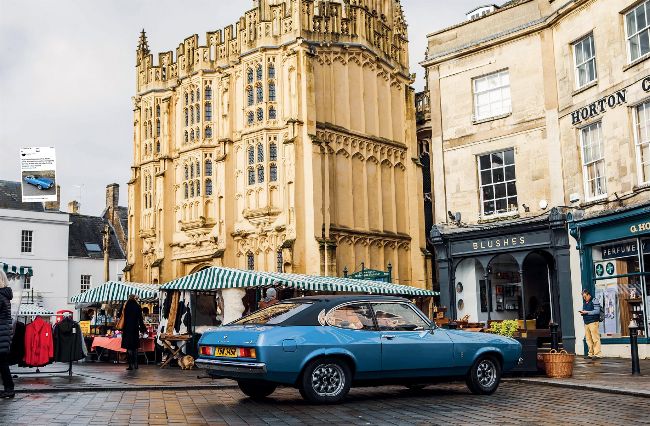
PHOTOGR APHY JACK HARRISON
We had travelled barely 200 yards, the Ford Capri and I, and just begun a gentle right-hand turn into a roundabout when a rattling sound, familiar but unexpected, transported me back four decades at the speed of light. Or more accurately, at the speed of thought, which is somewhat slower.
The noise was easy to identify: the fluttering sound a leaf fragment makes when it encounters the blades of a two-speed Ford heater fan running on Low. I’d heard it a hundred times in a Cortina 1600E I owned because, back then, Ford ventilation systems tended to ingest fallen leaves through an air intake grille ahead of the windscreen base, where they soon met the fan. When you cornered the car, the leaf shifted and the sound started. Or stopped. My homemade remedy was always to switch to High, hoping the extra blade speed would mince leaves to powder, and occasionally it worked.
Ironically, this sojourn in a 47-year-old Ford wasn’t supposed to be nostalgic. It was spurred by recent changes in the law. When Transport for London announced that certain cars, 40 years old or more, would be allowed to traverse the new ULEZ boundaries without paying the £12.50 charge, we fell to wondering how it would feel to commute through London in a car as old as that. Soon, the proposition widened: could a 40-year-old car do all of its owner’s motoring: country roads, motorways, night journeys, wet travel, suburbs and cities? Sure, there are plenty of classic car zealots who make an issue of doing just this (powerfully insisting the greenest car of all is the one you never scrap) but how would it strike someone such as me, cosseted every day by the best the modern car industry can provide?