45 Commando RM
Unit Biathlon Team Triumphs at Commandant General’s Cup
by Sgt Maughan, 2IC 45 Cdo Biathlon Team
In September, the Unit Biathlon Team claimed a resounding victory at the prestigious Commandant General’s Cup, cementing their reputation as one of the most formidable sports teams in the Royal Marines.
But behind the trophies and ‘gizzits’ there lies a deeper purpose: preparing for the unforgiving Arctic conditions where these skills can mean the difference between mission success and failure.
The Race: Biathlon is no ordinary sport. Combining the endurance of cross-country skiing with the calm precision of marksmanship, it demands a unique blend of physical power and mental control. Competitors must ski over punishing terrain, then steady their breathing to hit targets under pressure a challenge that mirrors the realities of Arctic warfare. For the CG’s Cup the skis were roller skis, the terrain a crumbled airfield and the challenging weather (booked by Billy Rodgers) simulated what only could be described as an aerodynamic wind tunnel test.
The roller skis were something new for most of the participants, with team entries from CTCRM, 29 Cdo Regt RA, 40 Cdo RM, 42 Cdo RM, 43 Cdo FP Gp RM and us. The race preparation involved three days of training with the newly formed RN/RM Nordic Ski Development Team alongside some range time on the brand new ‘Hoofin’ Biathlon Range here at RM Condor.
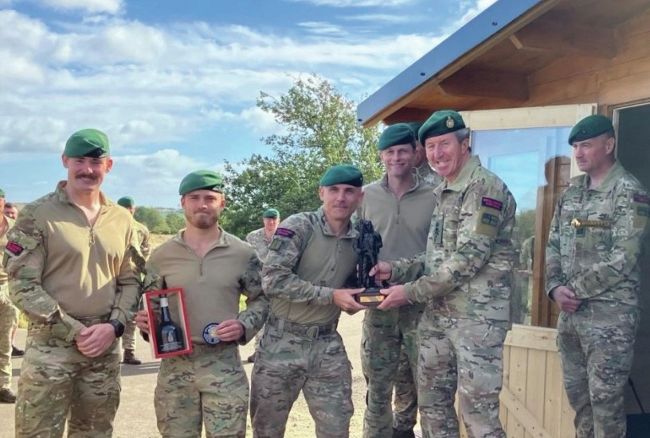
CGRM presenting the trophy
Why muscle conditioning matters in Nordic Skiing and Arctic Warfare: Muscle conditioning is essential for biathlon because skiing engages the entire body. Every major muscle group is involved: the legs provide propulsion across snow, the core maintains balance and stability and the upper body drives the poles to generate forward momentum. This full-body engagement means that strength and endurance must be developed evenly to avoid fatigue and maintain efficiency.
Beyond general strength, Royal Marines require both explosive power and stamina. The Arctic environment demands rapid bursts of energy to tackle steep inclines and deep snow, while also requiring sustained endurance to cover long distances during load carries. Without this combination, movement becomes slow and inefficient, which can compromise mission success. The ability to transition from high-intensity effort to fine motor control is what makes biathlon so challenging and so relevant to Arctic operations. Without rigorous conditioning, fatigue can undermine both skiing performance and marksmanship two skills that are absolutely mission-critical for Norway deployments.