JOYCE
Emulate the classic Amstrad PCW
Les Pounder goes back to school, a time when his form room was full of Z80 computers and noisy dot matrix printers.
Les Pounder is associate editor at Tom’s Hardware and a freelance maker. He blogs about hacks and makes at bigl.es.
QUICK TIP
Hidden in plain sight is Joyce’s menu. To show the main menu press F9 and then navigate using the mouse or keyboard. To boot from an alternative disk press F3 and then follow the standard disk menu.
At high school we had a business studies room, next door to our IT department (Goldstar 286 PCs and the RM Nimbus!), which doubled as a form room. Everyday we sat there for registration and important messages, but sometimes we were let loose on the computers. However, these weren’t x86 machines. Rather, they were Amstrad PCW8256 and 8512 powered by the mighty Zilog Z80 processor.
Amstrad, founded by Alan Michael Sugar (AMS-Trading) in 1968 was a well-known manufacturer of low-cost computers and consumer technology. Sometimes its consumer tech was maligned, but in the realm of computing Amstrad had success and gained a strong following. The company would later purchase the Sinclair brand from Sinclair Research (which saw new models of the ZX Spectrum being released).
Amstrad had a history of producing cheaper computing hardware, and in the case of 1985’s PCW8256 the £300 asking price (adjusted for inflation this is approximately £1,000 today), which was a steal compared to Apple’s $2,600 Macintosh Plus. But in classic Amstrad fashion, the PCW range was initially business focused and this saw a few cutbacks, and proprietary additions to the package.
As you can probably guess, the PCW 8256 has 256KB of RAM, while the 8512 came with 512KB. This was plenty for the era and the industry standard CP/M operating system. CP/M (Control Program/Monitor) was created in 1974 for Intel 8080-based machines. Loaded via a three-inch floppy disk, incompatible with 3.5 inch disks of the time, CP/M provided a basic OS from which we could launch programs and manage files.
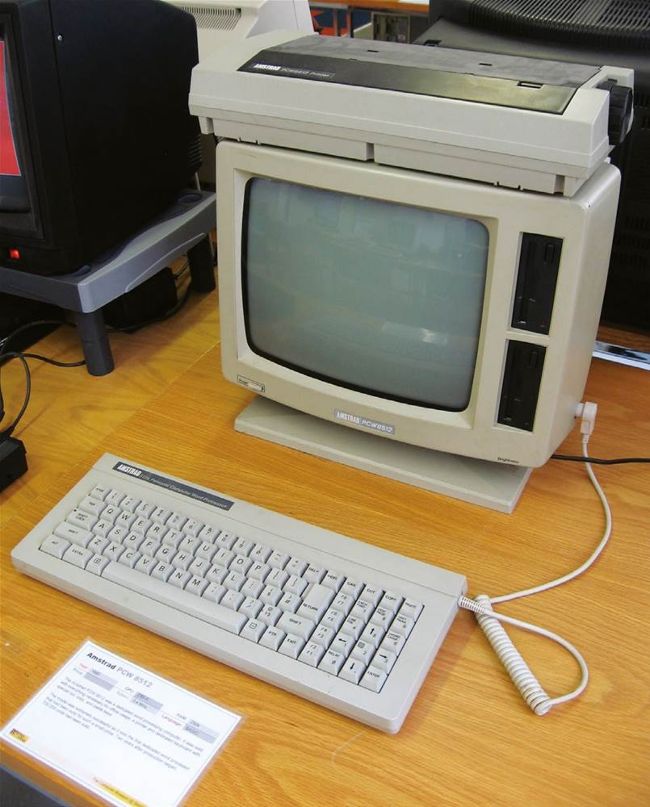
Designed for the office, the PCW8512 was a compact and cost-reduced business powerhouse that took on Apple for early DTP projects.
Going back to the disks, the choice for a three-inch drive was based on it having a simpler electrical interface. This meant that users had to purchase bespoke disks for their PCW, and for a short time these disks were hard to come by. The PCW 8256 and 8512 shared the same basic aesthetic: an all-in-one screen and disk drive (some with dual drives) with an 82-key keyboard connected via a DIN-type connection. The bundled dot matrix printer cemented the focus on home office/business use, but it also supported a popular desktop publishing scene.