a wild ride
Fuelled by cocaine, partying and a refusal to run with the nu metal pack, Deftones made an album like no other. Twenty years on, this is the story of White Pony
WORDS: ELEANOR GOODMAN
an unbearable, sharp pain in the head. A horrible realisation. A torrent of blood. Deftones drummer Abe Cunningham, relieved at finally finishing White Pony after four months of nonstop recording and partying, had ripped off his clothes and jumped backwards onto his bed for the best sleep ever. Only, there was a double-ended knife sticking out of the fireplace he was using as a headboard. He’d stabbed it in there a few weeks earlier, just to be cool. Now, he’d impaled himself.
“It was terrible,” he laughs today.
“I was naked, and I just knew. ‘Fuck!
I just hit that fucking knife, that goddamn knife!’ And I froze up. There was blood everywhere.”
It was a fitting conclusion to the chaotic creative process for one of the greatest heavy albums of the 21st century. There had been bloodshed, in-fighting, videogame obsessions, cocaine-fuelled parties and unexpected celebrity guests, these multiple voices and experiences fuelling the explosion of originality heard across White Pony’s 11 tracks. It was an evolution of their sound, an anomaly in the metal scene, and confusing for their fanbase. No one had seen it coming.
Deftones had formed in Sacramento in the late 80s and signed to Madonna’s label, Maverick, before releasing their debut album, Adrenaline, in 1995. It was a raw outburst of impulsive young energy, taking 90s alt-metal and mixing it with unhinged screams and blunt, abrasive riffs. Two years later, follow-up Around The Fur bumped up the quiet-loud-quiet dynamics and showcased more range and depth, propelling them to major festival stages and headline tours. In many people’s eyes, they were a nu metal band. But for album number three, they had something else in mind. Rather than continuing steadily along the same path, or adopting the swagger-filled posturing of rising peers like Limp Bizkit, they pushed into a new universe of endless atmosphere, unearthly textures and abstract lyrics. Instead of putting out party metal, they made ambitious, timeless, mind-expanding music while partying.
“We came off a couple of records that were pretty successful, but I felt like we had a lot more to do,” explains vocalist Chino Moreno. “A bigger voice, and really no rules.”
If you’d walked into Deftones’ rehearsal studio in midsummer 1999, you would have seen a 10-foot halfpipe. You might have witnessed Chino doing kickflips, or guitarist Stephen Carpenter trying tricks on his bike. ‘The Spot’ was part workspace and part clubhouse, with Iron Maiden posters adorning the walls and a steady stream of friends coming and going, shooting the shit or pulling off shove-its between practice sessions. Skating was such a priority that the band even measured how much space they needed to get their road-cases through, and only allowed an extra inch on each side so they could make the ramp as big as possible. “It was a hangout spot,” smiles Abe. “All the while, we would just be testing out new music and drinking beer, and having the time of our lives.”
“WE HAD MIMOSA MONDAYS, THEN MIMOSA TUESDAYS, WEDNESDAYS AND THURSDAYS”
CHINO MORENO
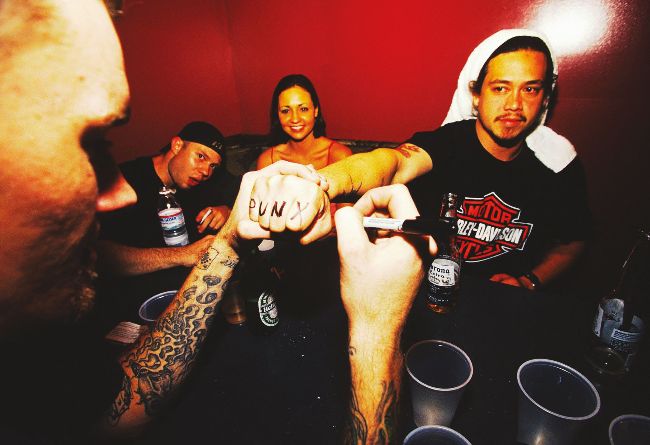
Sharpie-dressed man: Chi Cheng backstage with fans
By this point, Deftones had already begun work on White Pony, and had even displayed the iconic graphic on their backdrop for that year’s Ozzfest, their set sandwiched between Slayer and Rob Zombie. They’d also been trialling new song Korea, a low-down, grinding pit-crusher. At the tour’s close, Stephen had moved to Los Angeles, while Chino, Abe and turntablist Frank Delgado stayed home in Sacramento, tinkering with ideas at The Spot. A few times a month, Stephen would make the six-hour drive to jam with them. When he was absent, Chino would pick up one of Stephen’s guitars and experiment with it - something that would later cause friction.
“I was very green to the guitar, but I just loved playing it,” Chino explains in a soft drawl. “It’s kind of weird that I’m the singer, because one of my least favourite things to do is to express myself through words, and guitar is a great way to express yourself without having to do that. Although, Stephen wasn’t really too keen on it. He’s always been the guitar player, so I was treading on his ground a little bit. He never really told me not to, but I could tell that he was like, ‘Well, whatever. Let him get it out of his system, and then we’ll move on.’”