PRESERVATION
AN UPHILL STRUGGLE
For the Bowes Railway, dealing with the impact of Covid-19 has been the latest of several challenges in recent years. Graeme Pickering looks at how this unique standard gauge preserved rope-hauled railway is hoping for a resurgence as a visitor attraction.
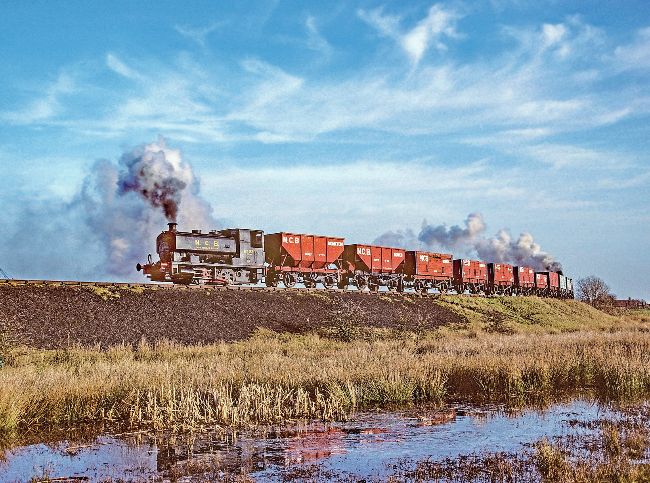
No. 22, built by Andrew Barclay in 1949, is a familiar sight on the Bowes Railway and was delivered new to Springwell shed in October 1949. The locomotive saw service on various parts of the railway and at other local National Coal Board sites. It returned to Springwell at the start of the preservation era and is pictured here on the Pelaw Main Curve.
PHIL WATERFIELD
FOUR miles south of Newcastle-upon- Tyne, high above the East Coast Main Line and the A1, is the surviving section of a once extensive colliery railway system.
George Stephenson was engaged as engineer for the first phase of what would eventually become known as the Bowes Railway, which came into operation in 1826, just months after the Stockton & Darlington Railway, for which he is universally known.
It evolved into a 15-mile main route stretching from Dipton in the west to the River Tyne at Jarrow, connected to a series of shorter lines. Over a working life of almost 180 years, it handled traffic from a number of different collieries and even in the middle of the 20th century (by which time it was in National Coal Board ownership), it continued to deal with more than a million tons of coal a year.
“I think you can use the word ‘unique’ for it now,” says Geoff Morrison, who leads tours at the railway and has been a volunteer there for 17 years.
“A hundred-and-odd years ago, it was just one of many such railways in the country, certainly in the North East. It’s the only one which has been left in preservation with the rope haulage system at least visible to view at the moment.
Special place
“The complex of buildings at Springwell, all the engineering works, the waggon shop, the joinery shop, the old stables for the horses and so on, in addition to its rope haulage character, just makes it even more special. It really is a very special place in terms of what’s been preserved, and thank goodness it was.”
At 6¼ miles in length, the first section of the route was built for Lord Ravensworth and Partners to connect Mount Moor Colliery at Blackfell, south of Gateshead and Springwell Colliery, which was in the process of being sunk, to Jarrow Staiths, where the coal would be loaded onto ships.
From the west, the first two miles consisted of three rope-worked inclines, with the remainder of the route to Jarrow being operated with steam locomotives.
In 1842 the line was extended across the Team Valley via two more inclines to serve George Southern’s Kibblesworth Colliery, but it was County Durham landowner John Bowes and his business associate Charles Palmer who provided the catalyst for the railway to take on its final form.
Bowes, the son of the 10th Earl of Strathmore and ancestor of Her Majesty Queen Elizabeth The Queen Mother (who officially inaugurated the railway’s preservation in 1976), established a company to reopen Marley Hill Colliery, south west of Gateshead. A half-mile of track connected the colliery to the Brandling Junction Railway’s Tanfield Branch (part of which is preserved as the Tanfield Railway) and this was subsequently extended two miles westwards to Burnopfield Colliery via a further rope-worked incline.