First-Aid AWARENESS
Have all your necessities ready for when health issues arise.
ARTICLE BY BRUCE & ELAINE INGRAM
When my wife, Elaine, and I began our chicken-raising career, we — like many first-timers — committed numerous errors. Indeed, the first three or four years, every single bird that came down with some malady died. We even came up with the maxim that “a sick chicken is a dead chicken.” One particular memory is especially painful to recall.
Boss was the first heritage Rhode Island Red rooster to ever lead our flock. Big, brave and also benevolent toward his hens and us, he possessed all the traits one desires in a roo. Then one morning, he seemed lethargic and didn’t crow; the second morning saw him increasingly sluggish, and a smaller rooster began pecking him.
Boss died the next morning, and while examining his vent area, I witnessed hundreds of maggots feeding on him. The poor creature had died of fly strike, and through our ignorance and hesitation, we had done nothing to save him.
Contrast that situation with what happened several years ago. One morning a pullet left the coop and instead of joining everyone else at the feeder and waterer, she plopped down in the dirt. I immediately went to her, searched through her wing and breast feathers for beasties and then tipped her over to examine the vent. There, I found about a dozen maggots; she was in the first stages of fly strike.
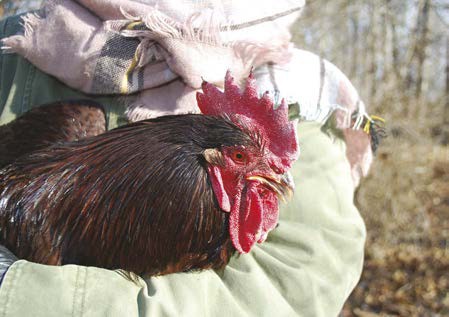
Vaseline can help soothe frostbite on chicken combs, especially those of roosters.
PHOTOS
BY
BRUCE
INGRAM
I immediately left the run with the young hen, called out to Elaine to ask her to set up our chicken hospital, and then shook Prozap Garden & Poultry Dust all over the pullet’s body with special attention to the vent and wing areas.