THE CLASSIC Rock INTERVIEW
MICK FLEETWOOD
He arrived in Swinging Sixties London as a dyslexic school leaver and aspirant drummer – and discovered a world of blues, booze, women and global success with Fleetwood Mac. But even after a half-century of making incredible music, perhaps his greatest achievement is keeping the wheels on rock’s greatest soap opera.
Interview: Henry Yates Portrait: Ross Halfin
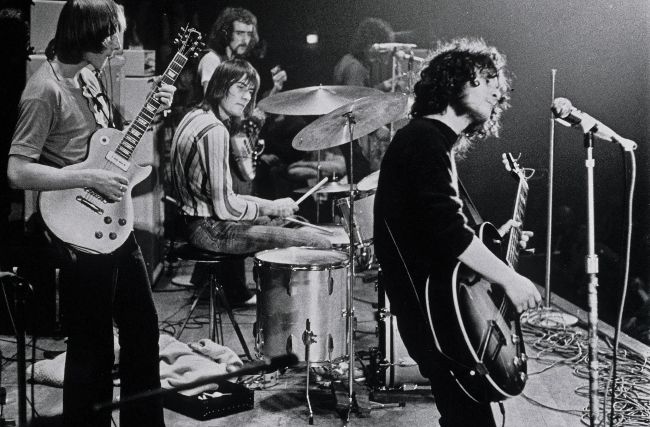
Shake your moneymaker: The early-days Fleetwood Mac at the Concertgebouw, Amsterdam.
You’d never guess that Mick Fleetwood has a starring role in rock’n’roll’s favourite soap opera. Perhaps it’s the island pace of his Hawaiian home, or the relaxation enforced by the pandemic, but a conversation with Fleetwood Mac’s co-founder and drummer is as calming as being in a hammock in a tropical breeze, the fractious life story of his fabled band at odds with his convivial telling of it.
Of course, we shouldn’t be surprised. While he’s no angel, Fleetwood’s abiding presence as referee, peacekeeper and hostage negotiator – always on hand to talk his more mercurial bandmates off the ledge, or hold the line when all seemed broken – is the reason Fleetwood Mac are now nudging past a half-century, with a catalogue of 17 studio albums. Fleetwood might be the groove, and along with bassist John McVie he’s also the glue.
He was born Michael John Kells Fleetwood in June 1947, and grew up across the globe as the son of an RAF fighter pilot. But his school years were torture for a teenager whose undoubted intelligence didn’t tick traditional academic boxes, and today he paints his move to London, aged 15, as his awakening.
A far more gifted thumper than he’ll admit, Fleetwood’s break came when his mentor, the peerless guitarist Peter Green, scouted him for John Mayall’s Bluesbreakers, then invited him to form Fleetwood Mac with him in 1967.
Swiftly delivering two of the British blues boom’s finest albums – 1968’s self-titled debut and 1969’s third Then Play On – the band seemed set for a smooth ascent. But chart-conquering singles like Albatross and Oh Well hastened Green’s mental health issues, and the guitarist left in 1970, a casualty of fame, acid and unknowable problems in his childhood.
With early guitarist Jeremy Spencer also burning out soon after, the Mac’s tradition of a revolving-door line-up was established. But the band continued, through an underrated transitional period in which guitarist Danny Kirwan found his voice on lost gems like 1972’s Bare Trees, before he too unravelled, refused to take the stage and was fired personally by Fleetwood.
Then came mega-stardom, with the 40-millionselling melodic rock of 1977’s Rumours, an album as famous for hits such as Go Your Own Way as for the failing relationships between lovers Stevie Nicks and Lindsey Buckingham, and married couple John and Christine McVie. And while in the past decade the Rumours line-up reunited for live shows, the wounds were still raw; Buckingham was ousted in 2018, although the reasons as to why differ according to who you ask.
Through it all, Fleetwood has played on, most recently at an all-star tribute concert to Peter Green, performed at the London Palladium just days before covid hit, and now set for release as a live album and film just months after the great guitarist’s death last July. It seems a good time for reflection on Fleetwood’s 73 years. And you couldn’t ask for a more genial host.
“My parents sent me off with their blessing, to go to London, with a funny little drum kit and a dream of being a drummer.”
What are your memories of childhood?
I was completely dyslexic as a child, and I had no acumen – zero – in terms of academic prowess, or any academic worth at all, really. I still don’t know my alphabet now. If you had a gun and you said: “Where’s ‘R’ compared to ‘S’?”, I don’t know. But I certainly never felt less-than, because I was never made to feel like that by my father and my mother. It was never even thought of.
They were always completely supportive of all their children. Actually, we all went into the arts. We were a family where you came to the door and my father would hug you. I remember the first time my father met John McVie, he gave him a big hug. And John told me: “It freaked me out, to have a man hug me.” I said: “Really? Your dad doesn’t hug you?”
How did the drums come into your life?
I think my parents were just happy that I was doing something, versus being completely and utterly useless at school. I had taught myself to play drums in the attic, playing along to Cliff Richard and Buddy Holly records and stuff like that. I left school when I was fifteen. And it was wonderful of my parents, because they sent me off with their blessing, to go to London, with a funny little drum kit and a dream of being a drummer. I had no right to think that I could do that at all. And when I got there I was as happy as a pig in shit.