masterclass.
WOK SCHOOL
From making sauces to stir-frying, steaming and deep-frying, your trusty wok really can be a one-stop pot. Here, Jeremy Pang reveals some of his best-loved recipes and techniques

PHOTOGRAPH: KRIS KIRKHAM.
FOOD STYLING: ROSIE REYNOLDS.
STYLING: MORAG FARQUHAR
“Mamak stalls are found across Malaysia and each has its own version of mee goreng (fried noodles), a dish with spicy but not overpowering flavours, balanced with sweet soy or kecap manis”
A LITTLE ABOUT JEREMY
School of Wok founder, author and TV chef Jeremy Pang comes from a long line of chefs and food lovers. He developed his zest for food after his family’s move from the UK to Singapore at age 10, and attributes his love of cooking to his father, who was eager to share his culinary joy and curiosity with his children. Jeremy is a TV regular, was a chef on
Ready Steady Cook in 2021 and can often be heard on BBC
Radio 4’s cookery show Kitchen Cabinet. The recipes here are from his latest book, out now.
FOR MORE WOK-COOKING TIPS SEE BE A BETTER COOK, P106
THE WOK CLOCK
“My Wok Clock has found its way into numerous classes and cooking demonstrations across the world. It’s such a simple and practical tool – away of reminding yourself to be super-organised in the kitchen. For those new to the Wok Clock, let me explain how it works.
At School of Wok, we like to arrange our prepared ingredients in a systematic manner, using a round plate as a clock. This method isn’t exclusive to wok cooking (though the name was so catchy it stuck); you can use it when organising ingredients for all types of cooking at home, no matter the cuisine. Once you’ve prepared all your ingredients, arrange them around the plate in the order in which you’ll need them, beginning at 12 o’clock and working your way around the plate clockwise.
Whether you’re cooking a stir-fry or a slower-cooked curry, or even setting up a long list of ingredients that need to be pounded with a pestle and mortar, the Wok Clock method works well. As a rule of thumb – when stir-frying for example – you tend to start with the base ingredients (onions, garlic, ginger) and the harder vegetables, then move on to the meats or other proteins, followed by the sauce or braising liquid. It’s that simple!
“Walking through Vietnamese markets you’ll often come across the aroma of barbecued pork charring on buckets full of hot coal. You’ll find this dish at specialist stalls, surrounded by queues of hungry office workers at lunchtime. Pounding the chops ensures they’re tender and juicy, so don’t skip this step”
“It’s the peanut sauce that makes this famous dish so moreish. Serve the sauce as here, in the classic way with marinated meat, or with fried fish and steamed rice for a quick, tasty dinner”
“Classic satay is usually served on a stick, which makes it fun as a street food but not so practical for a midweek meal. If you love satay as much as I do, don’t deprive yourself for the sake of the time taken to skewer each piece of meat. Just get your wok as hot as possible, sear away, then let your guests do the dipping and skewering”
Wok-fried satay
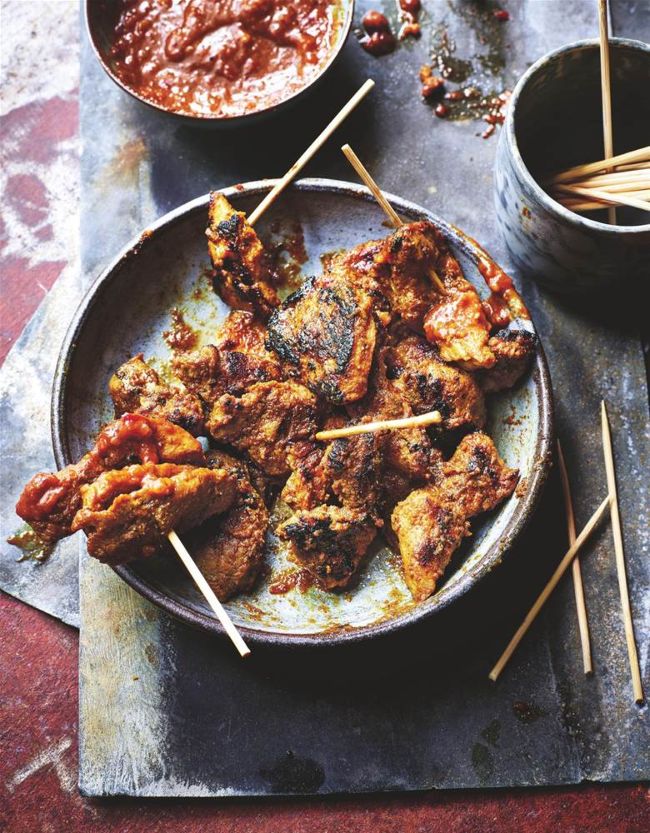
Wok-fried satay
Serves 2
Hands-on time 30 min, plus marinating
MAKE AHEAD
Make the marinade 24 hours ahead and rub into the meat. Cover and chill overnight in the fridge.
• 450g boneless pork shoulder; skinless, boneless chicken thighs; or rump steak (or a mix)
• 1 small cucumber, cut into bite-size chunks, and lime wedges to serve
• Vegetable oil for frying
• Satay sauce to dip (see below)