GB
  
You are currently viewing the United Kingdom version of the site.
Would you like to switch to your local site?
19 MIN READ TIME

HOW TO SHOOT CLASSIC LANDSCAPES

Arm yourself with the skills and techniques you need to become a master of shooting the great outdoors

Getty

The landscape provides a rich, varied and everchanging subject for the keen photographer. A typical approach to capturing the natural beauty of the great outdoors is to frame up with a wide-angle lens – anything from 16mm to 35mm is generally regarded as the focal length zone for shooting classic landscapes. But while a wide-angle lens means you fit more of a scene into your frame, this often causes extra compositional headaches that need to be overcome.

Over the next 12 pages, we’ll delve deep into the best approaches for shooting stunning landscapes. We’ll show how bringing together the art of designing your image, shooting at the optimum time, and using tried-andtrusted techniques to make sure your scenics technically hit the mark will ensure you’re never disappointed with your efforts. And we’ll touch on the other essential part of modern digital photography – polishing up those raw files to give every landscape photo you take maximum quality and visual impact.

While landscapes can be taken all year round, as autumn turns to winter, the shapes, structures and textures of the countryside become even more apparent. With the daylight hours shortening, too, sunrise and sunset also happen at a more civilised hour; so if you’re feeling inspired, grab your kit bag, put on your walking boots and waterproofs, and head for the hills.

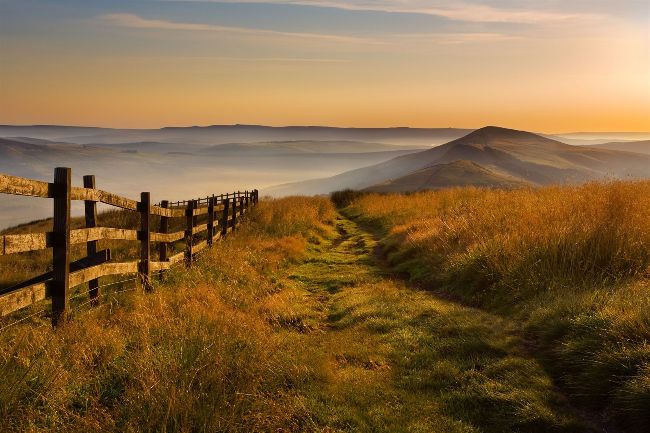
A classic, wide-angle landscape, shot at dawn with the sun low in the sky, on the Great Ridge leading to Mam Tor in the Peak District.

1 Building blocks The basics of classic scenics

Now you know what a classic landscape is, discover how to ‘work’ the scene and successfully combine the elements

You can’t just point your camera in the direction of a great scene and expect the results to look impressive. The key components of an outstanding landscape image can be broken down into four key pillars: the building blocks that make your photo stand out. Each of these adds its own important element; combined, they take your shots from being a snap of what’s there to a carefully constructed fine-art landscape.

1 Composition

When you have a wide-angle lens on your camera, a great foreground is essential in your classic landscape. Whether it’s something prominent like a large boulder, or more subtle textures leading you into the frame, the foreground is the base on which you build the design of your image.

2 Timing

You’ll never take your best images in perfect sunny weather or in the middle of the day. For a moody image with the best light, it’s important to be out shooting early and late, or when the weather is more unpredictable. This is when you’ll get the best conditions to accentuate the shapes within the scene, provide interesting skies, and give your composition an injection of drama.

3 Depth and sharpness

A classic landscape has depth, and is as sharp as possible from the foreground to the far distance. This sharpness allows you to capture all the interesting details and textures within the scene with absolute clarity, giving the viewer the sense that they could almost step into the photograph.

4 Movement

Admittedly not every classic landscape shot has to have movement, but when you can include it – perhaps as water flowing down a hillside, waving wheat in a rural field, or clouds scudding across the sky – it acts as the softer foil to the sharper edges of the land. You’ll need slower shutter speeds, though, from 1/15 sec to several seconds.

Unlock this article and much more with
You can enjoy:
Enjoy this edition in full
Instant access to 600+ titles
Thousands of back issues
No contract or commitment
Try for 99p
SUBSCRIBE NOW
30 day trial, then just £9.99 / month. Cancel anytime. New subscribers only.


Learn more
Pocketmags Plus
Pocketmags Plus

This article is from...


View Issues
Digital Camera Magazine
December 2021
VIEW IN STORE

Other Articles in this Issue


DIGITAL CAMERA WORLD
Welcome
This month we’ve put together an outdoor special to
Photo skills
Suzi Eszterhas
Graeme Green meets the wildlife photographer who goes to the ends of the Earth to capture her images of young animals
Life through a lens
Luke Davis explains how to create an eye-catching portfolio from everyday life
The big country
Dave Meades shows how to craft your own take on popular locations
Flower power
Francisco Kitzberger creates striking mono images with plants
Swap the sky for dramatic effects
Use the Sky Replacement filter to quickly transform your landscapes, says Claire Gillo
Hot wheels
Alistair Campbell explains how to capture dynamic shots like a pro while shooting fast‐moving events
I like the way you moo
Darren Harris deploys fieldcraft in search of beautiful winter wildlife
Top of the range
Louise Carey uses range masking for perfect exposure and colours in Lightroom CC
Natural portraits
Alistair Campbell pays a visit to Bath’s Botanical Gardens to combine people and nature
Awesome astro
Tony Wood shoots for the stars while sitting by the sea on the Jurassic Coast
Up in the air
Ritchie George explains how to get the best plane shots from the ground up
STAY AT HOME PHOTOGRAPHY
Keep calm and camera on with our guide to projects you can complete indoors
Camera College
The complete guide to modern photography
Show your true colours
Colours looking a little flat? Boost them with Affinity Photo’s powerful adjustments
Pep up your landscape shots with a new sky
Add drama and impact to any scenic shot with our Skies Kit and Photoshop’s Sky Replacement Tool
Master the Clone Tool
Fix distractions, remove messy details and clone in perspective with these essential Photoshop tool tricks
Marvellous masks made perfect
Explore a powerful new way to select and edit parts of your shot in Lightroom
Four ways to take control with Levels
Discover the versatility of a tool many Photoshop users take for granted
Photo Answers
Hazy over histograms? Annoyed about aberration? Send your technique and camera questions to digitalcamera@futurenet.com
Regulars
The art of seeing
In a flash of light, Benedict Brain makes a surreal connection with Portmeirion
Hotshots
Outstanding images from the 2021 Landscape Photographer of the Year contest Henri Abbott
Look ahead to 2022 with a CEWE Calendar
From summer holidays and weekend breaks to birthdays and anniversaries, it’s time to start planning your year in style
Shootout
How many distinctive photo opportunities can one find in a compact area of the built environment? Niall Hampton challenges two readers to exercise their creative muscles
Shot of the month
Cath Simard creates a blend of night and sunrise, halfway between dreams and reality
In Focus
The latest photography news from around the globe
Scanning ahead…
Jon Devo finds out how computer games are taking aim at photographers
Chris Burkard
Adventure photographer
Chris Burkard
Graeme Green meets the photographer whose thirst for adventure has taken him around the world in search of the perfect wave
What the f-stop?
How much do you really know about photography? Test yourself to the max every issue with our tricky trivia quiz!
Gear & tests
2021’sGIFTS GALORE FOR CHRISTMAS
Perfect presents to treat the one you love (or yourself)
Sony Alpha 7 IV
£2,399/$2,499
Apple iPhone 13 Pro Max
£1,049/$1,099
Help me buy a… Landscape lens
For broad vistas, an ultra-wide lens helps you see the bigger picture
What to look for in a landscape lens
Bear these important factors in mind when choosing your ultra-wide
Digital Camera recommends...
Here’s our top choice of landscape lenses for full-frame cameras
Also consider…
These ultra-wide-angle zooms are smart buys for crop-sensor bodies
Back issues
Download our digital editions, or buy in print while stocks last
Chat
X
Pocketmags Support