Peter van Agtmael
Niall Hampton speaks to the man who has spent the past two decades documenting key events in US history
Peter van Agtmael Photographer
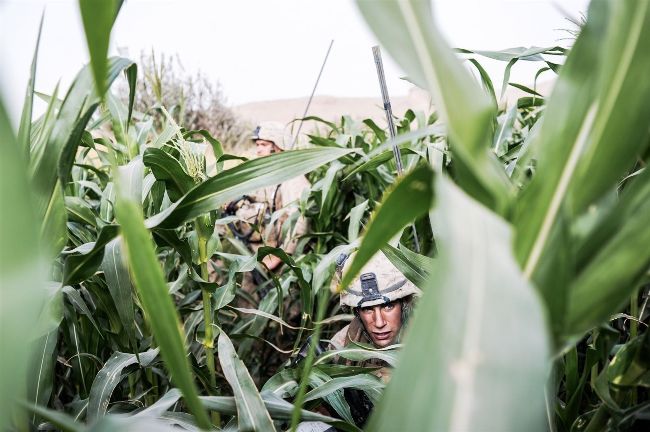
Before an ambush. Miam Poshteh, Helmand, Afghanistan, 2009.
Peter van Agtmael/Magnum Photos
Magnum Photos member Peter van Agtmael’s new book is called Look at the USA:ADiary of War and Home and the title describes the book perfectly. Over the past couple of decades, van Agtmael has been chronicling significant events, and the aftermath to them, in the US and overseas, including spells in Iraq and Afghanistan. Almost 200 photographs feature in Look at the USA, which can be a difficult read at times, with so many images of war and conflict. But van Agtmael’s use of diary entries alongside the images provides some useful context and allows the photographer to zoom out from the pictures to offer a wider view to the reader. Born in the USA but now resident in Paris, van Agtmael spoke to us from the French capital ahead of the book’s publication in the UK last month.
After graduating from Yale University, van Agtmael began documenting the United States at war and at home, which he has continued to do for decades.
Amentor in the Arab Documentary Photography Programme, van Agtmael joined Magnum Photos in 2008.
Books he has published include 2ndTour HopeIDon’t Die, Disco NightSept 11, Buzzing at the Sill, Sorryfor theWar and 2020.
Van Agtmael has received many photography awards, including a Guggenheim Fellowship, the W. Eugene Smith Grant, an ICP Infinity Award, and several World Press Photo awards.
www.magnumphotos.com
Look at the USA spans 2006-2022. Why did you want to put a book together from this period?
It has been 16 years of my life, photographing the consequences of 9/11 – or at least that’s how it started. It started with this direct notion of the wars that followed in the wake of this event. But as time went on and I realised my engagement wasn’t just a casual one, it became a kind of passionate obsession. In a way, my background was in history more than photography, so I wanted to broaden the lens and broaden the context.
It became an existential question for me, not just what are these wars we’re fighting and why are we fighting them, but to begin with, who are we who’s fighting them? What is it about our national character that allows us to stumble into these conflicts so recklessly and casually? That reality was very clear early on and only became more clear as time went on.