REVIEWS
DJI Mini 3 Pro
Price: £709/$759
DJI’s latest drone has the convenience of meeting sub-250g regulations, but does it cut it for serious use? Angela Nicholson takes to the air to find out
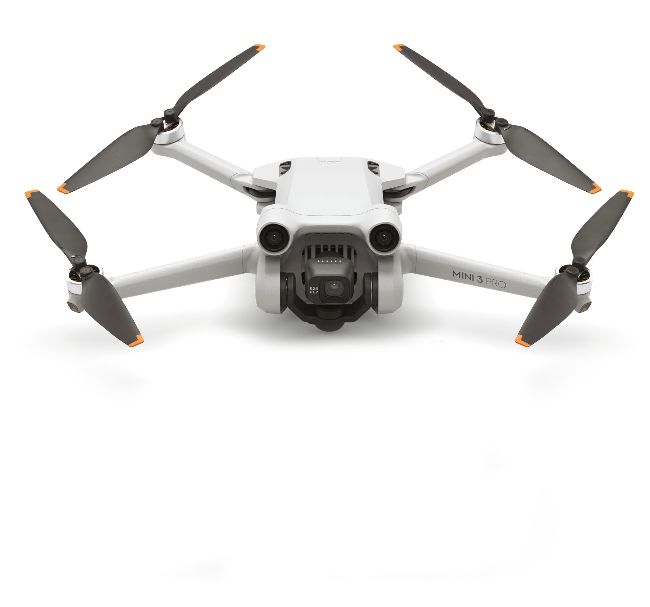
Gimbal-mounted camera The camera is mounted on a gimbal to enable smoother movement and shooting from a range of angles
The Mini 3 Pro is the latest arrival from DJI, the most widely-known drone manufacturer. It joins DJI’s Mini series of sub-250g drones, sitting above the Mini 2 in the line-up. That sub-250g weight is important because it means that the Mini 3 Pro avoids the restrictions imposed by the drone regulations on ones over 250g.
In the UK, provided you have Flyer ID and Operator ID from the CAA, which can be obtained by a simple online process, you can fly the Mini 3 Pro in residential, recreational and industrial areas, and even overfly people (but not crowds). However, you must still keep clear of the flight restriction zones around places like airports, prisons and military bases.
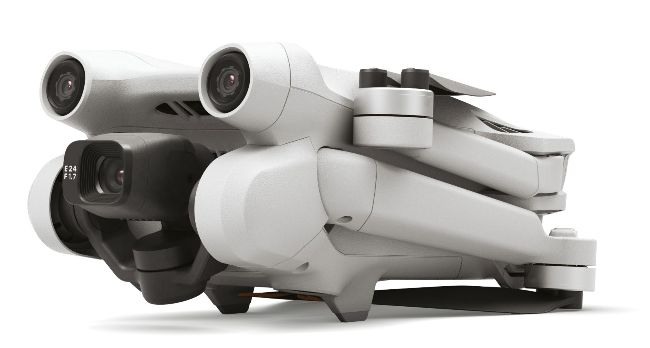
Folding arms The drone’s arms fold in against its body, making it easier to transport between flights.
Naturally, keeping the drone to such a low weight means that the Mini 3 Pro doesn’t feel as robust as a similarly priced camera. But it also makes the drone more portable, meaning that you can take it almost anywhere on the off-chance of a flying opportunity. However, I would recommend investing in a small case to keep it safe in a backpack with your other kit. Despite the weight restrictions imposed upon the Mini 3 Pro, DJI has managed to shoehorn in a larger sensor than is in the Mini 2. It has stepped up from a 1/2.3-inch type sensor to a 1/1.3-inch type device, which is good news for image and video quality. DJI has also opted for a quad-Bayer design for the sensor, which means that each pixel is divided into four sections that can report separately or together. As a result, the Mini 3 Pro can shoot 48MP or 12MP images. Further good news is that it can shoot either JPEG alone or RAW (DNG) and JPEG files simultaneously.