THAILAND DIVER
TURTLE TRACKERS
Every turtle has unique shell markings so can be identified – have you ever taken a shot of one in Koh Tao or the wider Gulf of Thailand? It could come in handy, as ALEX TYRRELL explains
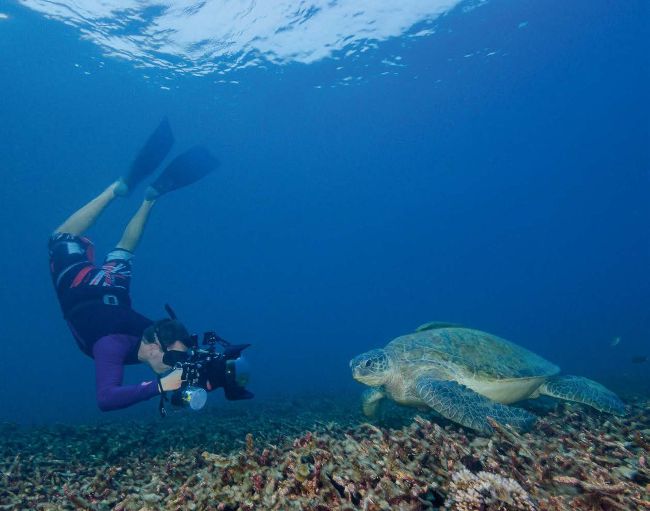
A photographer persuades turtle Maurice to pose for the record.
THE SMALL ISLAND of Koh Tao in the Gulf of Thailand is a popular dive destination, especially for training. From intro dives and open-water courses all the way to technical and pro levels, you can do it all here.
But this level of popularity has its environmental impacts, so the island also boasts a long history of marineconservation projects set up to offset these potentially negative effects.
You’ll find artificial-reef structures in numerous locations; beach and dive-site clean-ups are regularly organised; and mooring buoys are installed and maintained at all sites (no anchoring).
Many dive-schools have ecodepartments offering courses in marine conservation and these have led to longterm projects, including databases of both whale shark and turtle observations from the Koh Tao’s waters.
Both of these are citizen-science projects, with members of the public submitting photo and video evidence of sightings, used to identify and gain knowledge of the local population, and to track the movements of individuals.
Most divers know that individual whale sharks can be ID’d from the unique spot patterns on their flanks, using adapted astrological mapping software to log the markings, but did you know that turtles can also be ID’d by their markings?
Turtle sightings are frequent because so many individuals reside in specific areas (unlike transient whale sharks) so more data is available for analysis. A means of receiving and compiling this data was needed – so Koh Tao Turtles was born.
From Tao to Thai
Koh Tao Turtles was formed in 2015, spearheaded by Lena Schenke, an intern of the New Heaven Reef Conservation Program. A KTT Facebook page was set up to receive photo and video evidence, with material dating back to 2008 submitted by longer-term residents.