The Maestro
Dudley Simpson died on 4 November 2017 at the age of 95. A fellow Doctor Who composer pays tribute to the great man with the help of the people who knew him.
FEATURE BY MARK AYRES
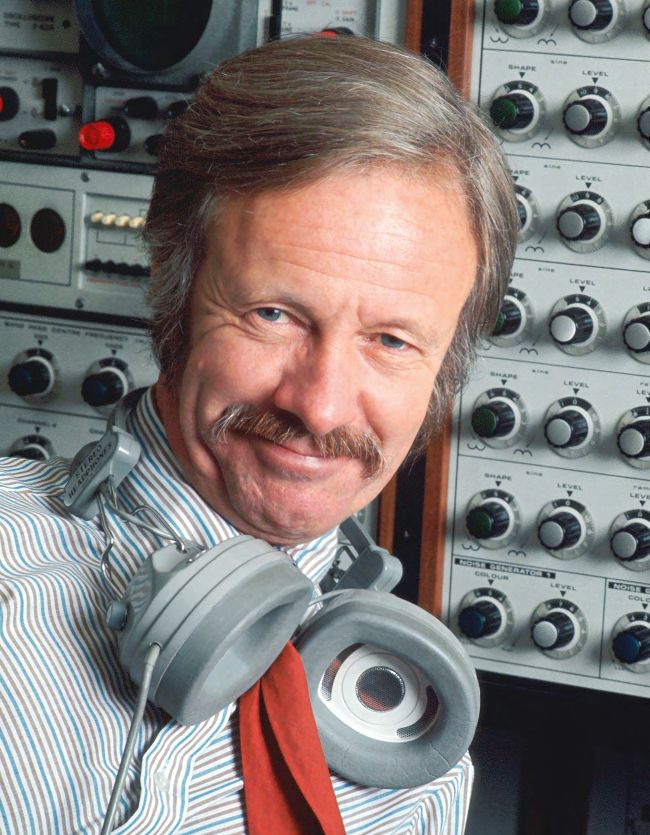
Composer Dudley Simpson in 1973.
Dudley Simpson
“The only thing is that I thought that if I do have music over his footsteps, you may not hear his footsteps prominently enough. If you time this first section for me I’ll have a rough idea of how much music I have to create for this, where the Chinese doll jumps out on him. I was thinking of the cello mixed with the marimba, and we’re going to use car springs for when he jumps out – you know, goes ‘zing…!’”
That was Dudley Simpson talking in Whose Doctor Who, an April 1977 edition of BBC2’s The Lively Arts. He was discussing his score for The Talons of Weng-Chiang with director David Maloney, and it was one of the most influential pieces of television I ever saw.
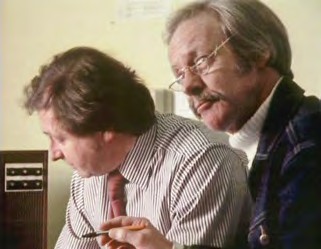
Dudley and director David Maloney pictured during the post-production of The Talons of Weng-Chiang in early 1977.
“I was thinking of the cello mixed with the marimba, and we’re going to use car springs for when he jumps out.” DUDLEY SIMPSON
When I was teenager, in the 1970s, I thought Dudley Simpson was the guv’nor. There were other television composers whose work I admired, including Tristram Cary, Geoffrey Burgon, Carey Blyton (who turned up as a visiting composer on a youth orchestra course I attended) and Norman Kay. Then there was the BBC Radiophonic Workshop, of course, and a few composers who never troubled Doctor Who, such as Christopher Gunning (The Day of the Triffids) and Barry Gray (most of Gerry Anderson’s output). But Dudley’s extensive CV encompassed just the kind of television I adored, from Doctor Who to The Tomorrow People, The Long Chase to Moonbase 3. I heard his work on The Brothers, The Venturers, Paul Temple, The Last of the Mohicans, Madame Bovary and the acclaimed 1973 documentary series The Ascent of Man. Later, there’d be Blake’s 7, Target and a number of the BBC Shakespeare plays. I admired his knack for a good tune – the capturing and setting of a mood. I loved the tone colours he achieved, and transcribed bits of Genesis of the Daleks (1975) and The Brain of Morbius (1976) in an effort to understand them. I worked my way through the grades in piano, flute and music theory and took music at O- and A-level. But listening to Dudley’s work was my early education in orchestration.