VIRTUALLY RADIOPHONIC
The BBC Radiophonic Workshop archive is now available for use by sound designers and composers everywhere thanks to a collaboration between Spitfire Audio and BBC Studios. Alex Hewitt speaks to Radiophonic Workshop archivist and composer Mark Ayres as well as composer and founder of Spitfire Audio Paul Thomson to discover how this groundbreaking project was brought to life.
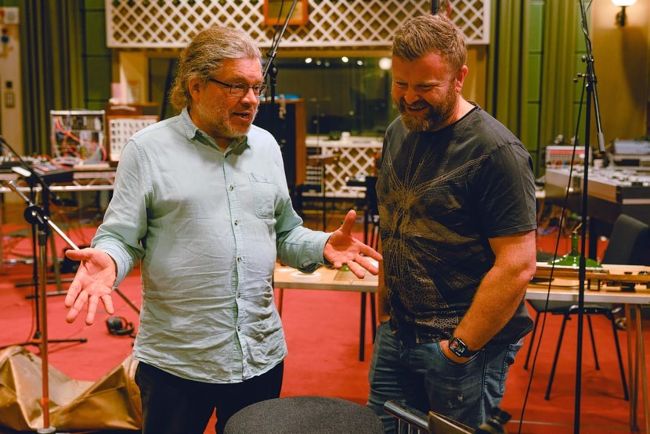
Mark Ayres and Paul Thomson.
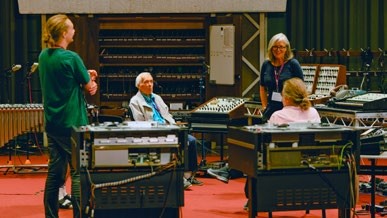
Roger Limb, Glynis Jones and Mark Ayres.
The BBC Radiophonic Workshop opened in 1958 to create new sound effects and electronic music for a huge range of BBC productions from Quatermass and the Pit to The Goon Show and, of course, Doctor Who. The Workshop continued to provide incidental music for Who throughout all 26 seasons of the 20th century iteration of the show but eventually closed down in 1996. Almost 30 years later, Spitfire Audio has digitised the unique sounds of the Workshop, as well as recording new effects with original equipment. Spitfire specialises in creating sound libraries of ‘sampled’ sounds – digital recordings of instruments and synthesisers which can be purchased, downloaded, and used by composers in their own projects. Also known as VSTs (virtual studio technologies) these sound libraries are used worldwide, and other Spitfire collaborators include the London Contemporary Orchestra and Oscar-winning composer Hans Zimmer.
The Radiophonic Workshop VST came off the back of Spitfire’s previous collaboration with BBC Studios, where they created a sample set of the BBC Symphony Orchestra. Spitfire co-founder Paul Thomson had formed a good relationship with two key figures at BBC Studios, namely head of music partnerships, Nick Baxter, and director of radio and music, Dominic Walker. Paul explains, “I had written a fair amount of music for the BBC, so Nick set up a meeting for us all to talk about the possibility of doing some kind of sample library together. The initial project was the BBC Symphony Orchestra. I remember saying to Dom, ‘It would be great if we could do something like the Radiophonic Workshop’.” Paul had been a fan of the Workshop’s creations from an early age: “I was a Doctor Who fan when I was a kid – Tom Baker was my Doctor.” In particular, Paul recalls scenes from classic stories from throughout the 1970s, such as Nightmare of Eden and The Face of Evil. “When I visualise the scenes from those I can hear the modulating synth sounds. The music is bound so much to the total experience that it leaves an almost indelible imprint.”