THE PRESERVATIONISTS
Digging through the archives with the people striving to safeguard videogame history
BY LEWIS PACKWOOD
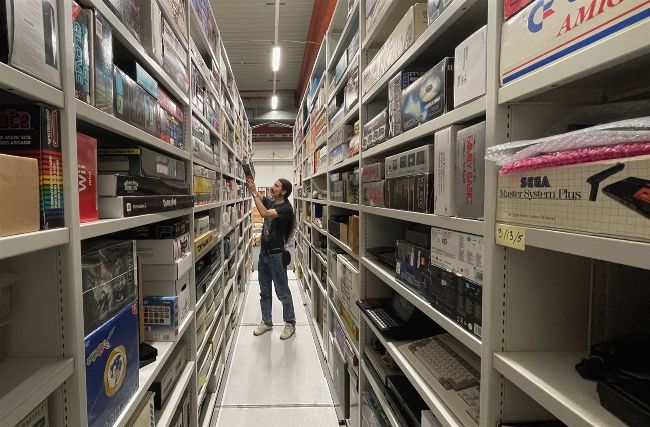
“It’s like a religious feeling, walking into the archive,” says David Boström, CEO of the Embracer Game Archive. “Every day just entering I get goosebumps. It’s an amazing feeling to be surrounded by so many games”

David
Boström
and
Natalia
Kovalainen
are
part
of
the
five-person
team
at
the
Embracer
Games
Archive
which
has
spent
the
past
eight
months
sorting
games
and
hardware
onto
custom-designed,
movable
shelving
units

Christian
Bartsch
of
the
Software
Preservation
Society.
The good news is that all is not lost. Far from it. Thanks to dedicated enthusiasts, collectors and professionals all over the world, the vast majority of works from the first few decades of videogaming history still exist in some form. It’s a marked contrast to the parlous state of film preservation, for which a 2013 study found that 75 per cent of American movies made before 1929 are lost or survive only in part.
But there’s little room for complacency. Unlike with books, say, there are no national institutions or libraries dutifully collecting a copy of every single published game, so it’s up to museums, societies, companies and individuals to preserve videogaming’s early history. Faced with constraints involving storage space and funding, it’s impossible for them to collect everything (although that hasn’t stopped some from trying, as we’ll see later). Instead, they tend to focus on specific niches of gaming, such as certain platforms, eras or themes. The result is a hotchpotch of collections scattered across the world, each maintained by groups with differing priorities and philosophies regarding how videogame history should be preserved.
In talking to a number of groups representing preservation efforts in the US, Europe and Japan, we can take a snapshot of the scene as it exists today, and survey the range of approaches being used to safeguard the legacy of gaming’s earliest pioneers.
The most urgent issue facing preservationists is the rapidly decaying media used to store early games, particularly magnetic tapes and floppy disks. “At some point, the data is going to fall over the digital cliff, when the data degrades beyond the point where we can read it properly,” says Christian Bartsch of the Software Preservation Society (SPS), which is headquartered in Twickenham in the UK but has principal members in Germany, Finland, Hungary, France and the United States. “So that means the clock is ticking.”
Magnetic media is prone to bit rot, which sees the magnetically stored data lose charge over time, effectively erasing parts of the disk or tape. Contrary to expectation, Bartsch says that more advanced high-density floppy disks from the 1990s are more prone to bit rot than earlier, low-density disks, seemingly because the densely clustered magnetic charges repel each other. “A lot of PC games made in the 1990s are already broken or generate read errors,” he says, “whereas many of the C64 and Apple II games from a decade earlier still work fine.”
Importantly, the likelihood of a decades-old disk functioning today is largely down to how it has been stored. Excessive humidity, fluctuations between high and low temperatures, and exposure to direct sunlight or magnetic sources can all spell doom for a floppy. A common problem is that mould can form on the disk or tape, gradually eating away at the surface. The coating can even loosen and become detached, scraped off in gradual amounts by the retrieval hardware’s read/write head. In that case, Bartsch says a last-ditch attempt can be made by baking the disk or tape in an oven at a certain temperature to fix the coating in place before risking a final, one-off read of the data, but the chances of success are extremely low when a disk has decayed to such an extent.
The SPS was formed by István Fábián, a principal engineer at Sony Interactive Entertainment Europe in London. Back in the early 1990s, Fábián worked on a number of Amiga games at Hungarian studio ArtGame, but when he tried to replay them via emulation in the early 2000s he was shocked at the state of the available software. “I saw that everything that was left were basically cracks,” he says. “Nothing much original remained. And that included, unfortunately, my very own games.”