FLYING SOLO
Going it alone in modern game development
BY LEWIS PACKWOOD
With the unprecedented wave of layoffs the game industry faced in 2023, more developers than ever before are wondering whether they can make it on their own. Surely, the thinking goes, striking out alone must beat toiling away for an employer that might not even want you sticking around once your current project has shipped. But does the reality stand up?
To find out, we talk to four solo developers to discover their experiences. Tomas Sala quit the company he founded to make The Falconeer; Lucy Blundell abandoned a career at Chillingo to create the acclaimed visual novels One Night Stand and Videoverse; Madison Karrh only found enough stability to leave her job making medical simulators with her third game, Birth; while Joe Richardson, creator of The Procession To Calvary, has only ever known solo development.
How lonely is it to make games without a team in support? What kinds of compromises – artistic and financial – are required? And is all the risk worth it to be master of your own destiny?
SHED WORKS
Tomas Sala works out of a wooden shed in his garden, a studio he built with the money he made from The Falconeer. He shares it with his wife, who has a ceramics workshop under the same roof. Even though he found the release of The Falconeer stressful, and spent a long time fixing bugs and working hard on the console conversions, he’s ultimately pleased with its performance. “I really can’t complain about how it’s gone,” he says.
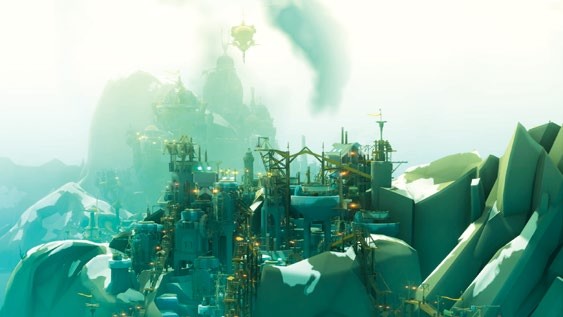
Tomas Sala (left) is currently working on Bulwark: Falconeer Chronicles, a sequel to The Falconeer which ditches flight in favour of city building
Tomas Sala clearly has no regrets about leaving behind the corporate cage he helped to build. “I hate fucking Scrum and Trello, all this fucking Jira,” he spits. “It drives me up the wall.”
After co-founding Little Chicken Game Company in Amsterdam with his brother and two others in 2001, Sala spent the next decade and a half building up the firm, which at one stage employed around 30 people. The company mostly took on work-for-hire jobs, which Sala says helped him to build up his skills by working on a wide range of projects. But he didn’t like being the boss, didn’t like having to constantly organise a team of people. “I am incredibly chaotic,” he admits.
Sala started making mods to decompress, eventually releasing the Skyrim-based Moonpath To Elsweyr in 2017. It was received well enough to encourage him to start work on a game of his own, called Oberon’s Court. Sala’s wife, Camille, pointed out how the darkness of Oberon’s Court reflected the burnout he was experiencing at the time. The realisation prompted Sala to rip up the project and build something entirely different using the assets he’d created. The Falconeer, a breezy aerial combat adventure inspired by Crimson Skies, was the result. It’s tempting to see it as a reflection of his flight from the corporate world.
It’s certainly a freedom in which he has revelled. Sala believes that boiling game development down into a list of tasks, as encouraged by project-management tools such as Jira, can turn what should be a creative adventure into a slog. Instead, he prefers exploring, chasing “that subconscious flow” in the manner of “creators outside of games who aren’t stuck to that Jira fucking pegboard”. Though Sala insists he is “quite disciplined” and keeps track of the things that need to be done in any given week, he also allows himself the room to deviate from that path when inspiration strikes. Such as waking up with the idea of making flying eels with guns, for example, and then diving straight in to create it. “I love feature creep,” he says. “It’s my entire design philosophy.”