GODS AMONG US
DENZEL WASHINGTON
This month: The leading man who radiates authority
In our regular series, we pay tribute to the towering, mega-watt stars who still roam Hollywood
WORDS IAN FREER
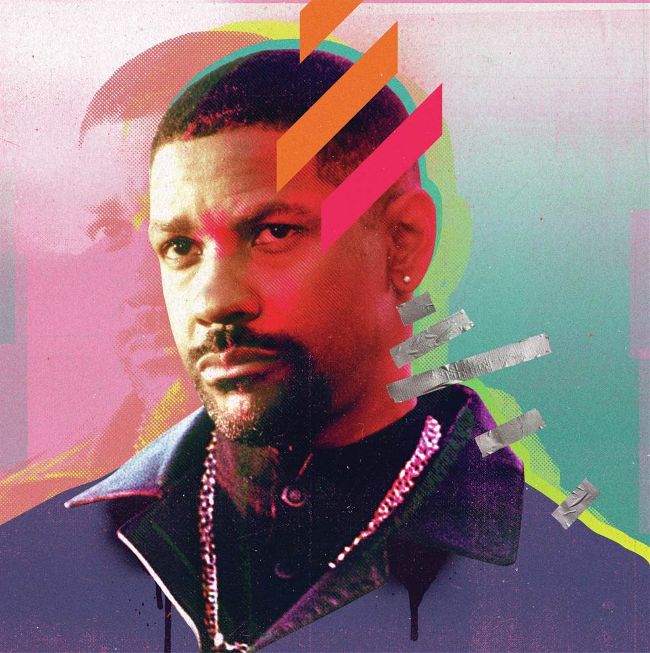
ILLUSTRATION CHRISTOPHER LEE LYONS
SO STEADFAST IS the character of Denzel Washington, you have to look far and wide to discover some offscreen sizzle. But there is some. In 1994, shooting Tony Scott’s Crimson Tide on stage 16 of The Culver Studios, Washington went toe to toe with uncredited co-writer Quentin Tarantino about the number of racial epithets in the submarine script. When Tarantino replied, citing the need for realistic dialogue, Washington didn’t back down. “He’s a fine artist,” Washington later said to GQ magazine about Tarantino, “and I told him my feelings. So, he knows what I had to talk about.” You can count on Denzel to be direct. To speak his mind. And in facing off against Tarantino on this matter, the altercation suggests traits Washington shares with practically all of his characters: inner strength, and authority.
Some people crave authority (or, in the case of South Park’s Eric Theodore Cartman, who lives for it: “authoritah”). Others — such as Denzel Hayes Washington Jr — just ooze it.
Maybe more than any other actor working today, in Denzel (or ‘D’ if you’re Spike Lee) we trust. His characters are self-possessed, articulate and in control. He doesn’t play wackadoodle outsiders or snivelling losers; instead he inhabits cops, lawyers, military types, activists, and, in Joel Coen’s upcoming The Tragedy Of Macbeth, a Scottish king.
Learning his craft on stage, he is technically gifted — his on-point British accent in 1988’s crime drama For Queen And Country makes it a crying shame he never played James Bond — but never performative. His taste in projects skews towards the adult. There are no superhero films on his CV and only one sequel, 2018’s The Equalizer 2, although his PI Easy Rawlins in Devil In A Blue Dress (1995) could have easily carried a franchise.
In some ways Washington is a throwback, his charisma and gravitas invoking earlier talent. Early roles (1991’s Mississippi Masala, Devil…) suggested the smouldering intensity of Paul Newman — Washington was voted People’s Sexiest Man Alive in 1996. He later grew into the kind of integrity and stature associated with Henry Fonda or Gregory Peck. In the pantheon of Black stars, he is a natural successor to his mentor and idol Sidney Poitier, but with one crucial difference. Blazing a trail, Poitier mostly played perfect, idealised role models.
THE BOX OFFICE
Denzel Washington’s top five money-makers*
AMERICAN
GANGSTER
$270 million
SAFE HOUSE
$208 million
PHILADELPHIA
$207 million
THE PELICAN BRIEF
$195 million
THE EQUALIZER
$192 million
* Global box office, according to BoxOfficeMojo.com
Washington just plays the truth.
Washington first met Poitier in 1981 while starring in the off-Broadway production of Charles Fuller’s A Soldier’s Play. The older actor took the young buck under his wing and schooled him in the ways of a Hollywood career. An early pearl of Poitier wisdom — “If they see you for free all week, they won’t pay to see you on the weekend” — has served Washington well.
A key weapon in his arsenal as an actor is that we know practically nothing about him. He’s been quietly married to actor Pauletta Pearson for 38 years (their son John David Washington is racking up an impressive array of credits, from BlacKkKlansman to Tenet). He has never been a fixture in the gossip columns, doesn’t overshare to Jimmy Fallon or bare his private life on Insta. It’s much easier to believe in his integrity on screen when there isn’t anything to dispute it off screen.