GANGING UP
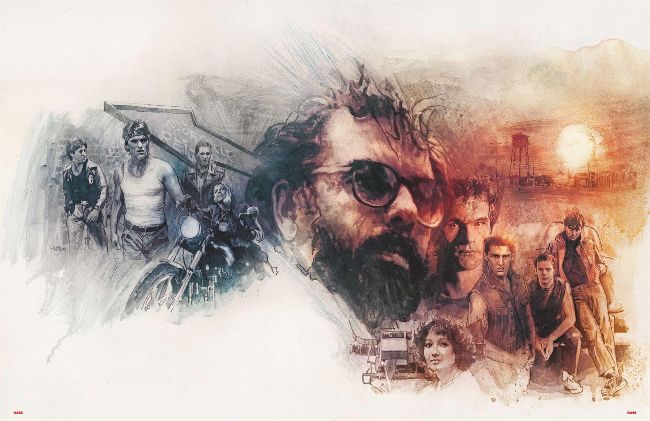
ILLUSTRATION TONY STELLA
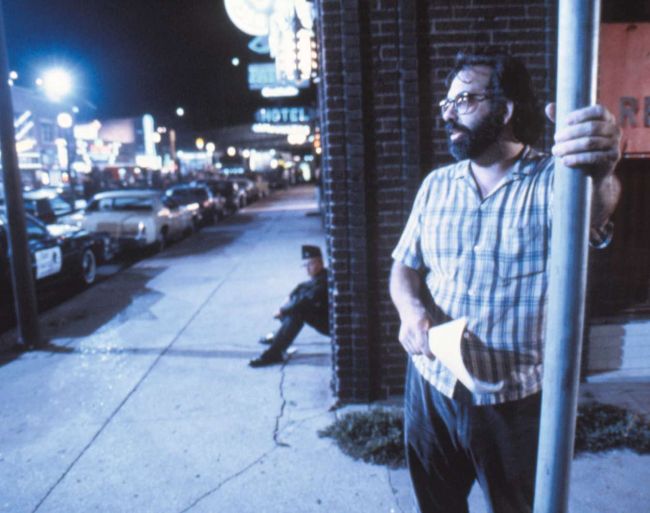
Director Francis Ford Coppola surveys the set of 1983’s
Rumble Fish.
Francis Ford Coppola has always gone rogue. Hollywood’s own Colonel Kurtz, he strays off the path, forging his own ones. You never know what to expect from his films: just that he pours his whole self into them.
Just a few years after Apocalypse Now and The Godfather Part II, the double-whammy of The Outsiders and Rumble Fish, made back-to-back in 1982, cemented his unpredictability. Even Coppola didn’t plan it like that. The first was a Gone With The Wind-indebted epic for teenagers, the second, conceived on the fly, an experimental art film. It was a time of turmoil, and this excursion was a means of escape and financial rehabilitation. His romantic musical One From The Heart had tanked, its budget having expanded from $15 million to $26 million, much of it personally funded by Coppola, whose studio Zoetrope produced it. When it was released in February 1982, it made just under $637,000. Bankruptcy beckoned. “I made The Outsiders after the demise of my dream studio,” he reflects now.
“I lost the studio and much of the wealth I had built up. So I was in a position where I was paying back the bank, basically.”
The Outsiders was the first step on Coppola’s road to recovery. But there was nothing cynical about it. Feeling rejected by the industry and audiences, he saw it as a chance to get away from it all, to run off to Tulsa and make a relatively small film with a relatively unknown cast of teenagers. It would be fun.
In the end, he had so much fun he hung around and made Rumble Fish too. Both adapted from S.E. Hinton novels, they both celebrated youth, both featured gangs, both explored loss of innocence, and some cast and crew overlapped. But they couldn’t have been more different. And they were just what Coppola needed.
HIS SAVIOUR CAME IN THE FORM OF A librarian. Jo Ellen Misakian worked at the Lone Star School in Fresno, California, when she wrote to Coppola in March 1980. Her pupils — aged 12 to 14 — loved The Outsiders, Hinton’s 1967 romanticised novel about rival school gangs the Greasers and Socs (short for Socials), and Misakian thought Zoetrope could be a good fit for an adaptation. A petition was signed by 110 students, pleading with Coppola to make it so.
“I grew up in a greaser neighbourhood,” says Susan Hinton of the novel’s genesis. She was a prodigy: she began writing The Outsiders at 15, completing it at 16. She’d been raised in a workingclass town but also “got put in an AP class — college track — and there were lots of Socs there,” she says of the wealthier gang, “so I had a good understanding of both sides.” And then there it was: a violent inciting incident. “A friend of mine who was a greaser got beaten up on his way from school. So I began a short story about a kid who got beaten up on his way home from the movies. That was the beginning of The Outsiders.”