Finding clues in your family photo albums
Jayne Shrimpton reveals the ancestor-hunting clues in our old family picture collections
ANCESTOR PHOTOGRAPHS
Jayne Shrimpton
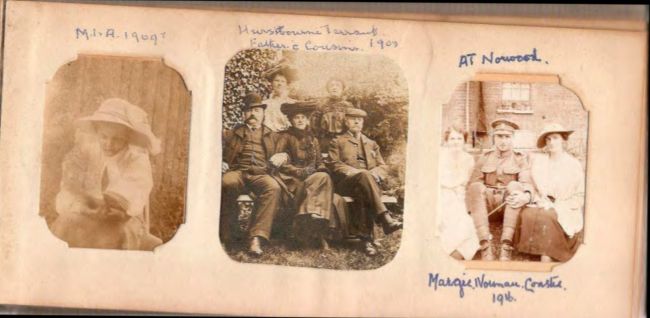
Early snapshot albums often had pre-cut apertures and the photographic prints were rather small. Sometimes names, places or dates were written close to the picture, as in this album from 1909
Some family historians are lucky to have inherited not only old photographs, but also original 19th- or early 20th-century photograph albums compiled by past generations. Here we examine the evolution of photograph albums, with tips for dating surviving albums from different eras and understanding their contents.
Early photograph albums
In around 1858 the neat ca de visite photograph measuring a standard 10 x 6.5cms arrived in Britain from France – the first mass-produced cardmounted photographic print. A few UK studios began trialling cartes (cdvs) in 1859, but 1860 was the first significant year of production. The novel format rapidly became fashionable, inspiring a craze for commissioning, exchanging and collecting cdv photographs of relatives and friends, as well as portraits of famous personalities of the day – a craze known as ‘cartomania’. This new trend inspired the production of the first purpose-designed photograph albums, the availability of albums in turn prompting the taking of more cdv photographs. Indeed, during the early 1860s, cartes de visite were known as ‘album portraits’, demonstrating the close relationship between the popular photographs and the fashion for displaying them in albums.
The first photograph albums were produced in France, but by the summer of 1861 they were available in Britain from various companies. Designed to look externally very much like the traditional family bible or hymnal, the first albums were solid tomes with heavy embossed leather bindings and sturdy metal clasps. As Audrey Linkman explains in The Victorians: Photographic Portraits (Tauris Parke, 1993), the conscious emulation of devotional books endowed the new photograph albums with something of the respect and awe accorded to the Christian religion in Victorian Britain. The connection also inferred that a collection of family photographs in a handsome volume might even replace the tradition of recording births, marriages and deaths inside family bibles, one contemporary commentator describing the album as ‘an illustrated book of genealogy’. From the mid- Victorian era onwards, the photograph album would become a treasured repository of all that a family held dear.