INDELIBLE memories
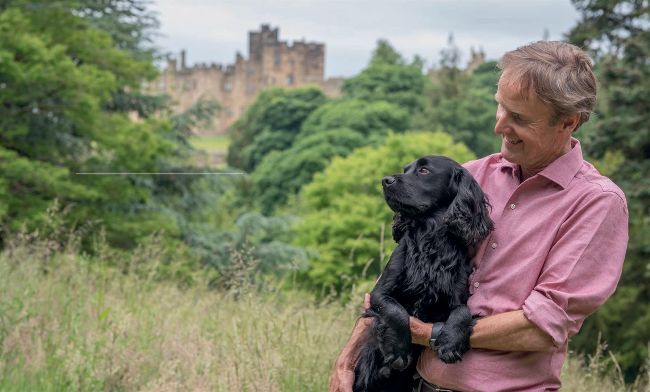
A well-known and tireless conservationist, The Duke of Northumberland is patron of numerous wildlife charities. Formerly president of Salmon & Trout Conservation and current vice president of the GWCT, he has won several notable awards including the Purdey Award in recognition of his groundbreaking work to halt the decline in grey partridge numbers. His younger brother James Percy met him at home at Alnwick Castle to find out more
Photographer
PHIL WILKINSON
Why do you think that both of us grew such a love of everything to do with the countryside, especially for fishing and shooting, from such a young age?
As children, we were incredibly lucky to have fishing and shooting on our doorstep, and a father who encouraged us to make the most of it. Gamekeepers taught us about nature and how to shoot fairly straight, and one of these mentors enlightened us to the darker side of fishing; with the upstream mepp, the worm and the ‘drop’ minnow. (And the gaff, in my case). The latter involved netting minnows in the shallows, then packing them into a tin of salt and leaving them for several weeks before use, involving us in a lengthy process and ultimately teaching us the ways of the minnow and the trout, and the importance of stealth and patience. Inevitably, like most boys, we became competitive, and fieldcraft became a vital tool in the search for glory. We learnt how to outwit elusive quarry and to respect and appreciate wildlife and, no doubt, this evolved into a deep respect for the countryside and the flora and fauna within it.
Would you agree that your passion for conservation, and in particular the amazing success of the Alnwick grey partridge project, and all the wider benefits to other species that we have seen as a result of your work, has developed from such a keen interest in fieldsports?
We grew up in the post-war agricultural revolution, when intensive farming became the norm. Maximum yields were produced with modern methods, machinery and chemicals, and for a rural estate dependent on farming revenue, concern for wildlife was a relatively minor one. As a result, ground-nesting birds were chewed up in vast numbers by silage cutting (still one of the biggest killers of endangered wild birds like the curlew and the grey partridge), insects were poisoned with pesticides, hedges were removed to make bigger, more sterile fields and field margins were ploughed up. To someone with a love of the countryside, engendered by fieldsports, this was untenable, and it became essential to try and reverse the decline within a productive farming system. It was a particular passion for the grey partridge, and an ambition to grow their population and eventually harvest a few birds, that became the project’s driver. Two decades from when we started the project, it is fantastic to see and hear all the wildlife re-emerge, with the grey partridge, from the silent desert that our farms had become.
Having led such a charmed sporting life, growing up at Alnwick, surrounded by country people, and generations of gamekeepers with encyclopaedic knowledge, would you agree that both of us have evolved into identifying as conservationists rather than shooters?
You and I now spend much time on the Border moors of Lammermuir and Cheviot in spring and summer, with a highly expert team of keepers whose task it is as much to deliver real life conservation of all species as it is to encourage a healthy surplus of grouse, and the extraordinary benefits to habitat and wildlife that you see on the moors are plain to see. In our youth we were more interested in shooting grouse than creating wildlife havens, but age has brought greater appreciation of these extraordinarily rare, rich and diverse habitats, and the vital role that they play as breeding grounds for many species, some in serious decline. In the Lammermuirs I see the relationship between habitat management, predation control, the changes in prey populations, and their effect on increasing numbers of golden eagles and other raptors. It is a dynamic that’s constantly changing. My heart lifts when the first golden plover, ring ouzel, wheatear and curlew appear in the spring. I feel honoured that they should take up residence on the land in my care. They are there, of course, because of the 150 different types of moth, countless other insects, juniper, blaeberry, cotton grass, heather and pristine watercourses that provide for their every culinary need, as well as gamekeepers to protect them from predators. My highest respect goes to the permanent residents: the red and black grouse, the mountain hare, the dipper that dashes up and down the streams, the sturdy stonechat, meadow pipit, skylark and even the little wren, sheltering shyly in overhanging heather and crevices by the frozen streams. Ignorant, disingenuous, but vocal opponents of grouse shooting like to describe managed grouse moors as ‘wildlife deserts’ and their rhetoric is lapped up by some in the press who perceive grouse shooting as the unacceptable pastime of tweed clad toffs and don’t understand or want to understand the benefits of grouse moor management. In reality, you need look no further than Sitka spruce plantations if you want to see real upland ‘wildlife deserts’. There is little press interest in questioning government policy that encourages Sitka planting, despite its destruction of vast areas of wildlife habitat and its increasing role in the curlew’s path to extinction.