THOMAS TUCHEL
THE MONSTER WITHIN
He’s already transformed Chelsea into trophy winners, but Thomas Tuchel’s journey towards conquering Europe has been far from plain sailing. Brilliance has often collided with belligerence, to dramatic effect...
Interview Ed McCambridge
The tale of Dr Jekyll and Mr Hyde tells of a man corrupted by an inner demon –a destructive form of himself that rears its head unexpectedly.
Dr Jekyll is intelligent, friendly and agreeable; Mr Hyde the very opposite. And yet they are one.
There are shades of Thomas Tuchel in Robert Louis Stevenson’s infamous character. In a career where the German has risen from crocked lower-league footballer to celebrated Champions League-winning coach, he has also been repeatedly derailed by episodes of antagonistic behaviour.
As a player, Tuchel was described as “exacting and demanding, which didn’t go down well with some of his team-mates” by a former coach. His will to win meant that anyone not pulling his weight was quickly confronted. Yet, when a knee cartilage injury curtailed his playing days, it was Dr Jekyll, not Mr Hyde, who made his first steps into management. There was little sign of his darker side in 2005 when, aged 32, Tuchel went to Cologne to gain his UEFA Pro Licence.
“He didn’t show that side of himself during his time on the course,” Erich Rutemoller, Germany’s assistant manager between 1994 and 2004, and the UEFA course leader in Cologne, tells FFT. “These conflicts only arise when you are thrust into management full-time. But Thomas was clearly intelligent, and a smart coach knows which conflicts to engage in and which not to.”
Rutemoller admits to immediately liking Tuchel, a young man with an “excellent academic background”. The prodigy had already earned a degree in sports science, which put him a step ahead of some of the other students.
“I got the impression that he would have no trouble with the training, because he already had a good foundation of knowledge and experience built up,” says Rutemoller.
“Perhaps because his playing career ended so early, he felt an added motivation to succeed as a coach.”
Tuchel passed with flying colours before returning to his post as Augsburg’s reserve team boss. So impressive was his tactical understanding and meticulous preparation, it wasn’t long before senior football – and all of its trials – came calling.
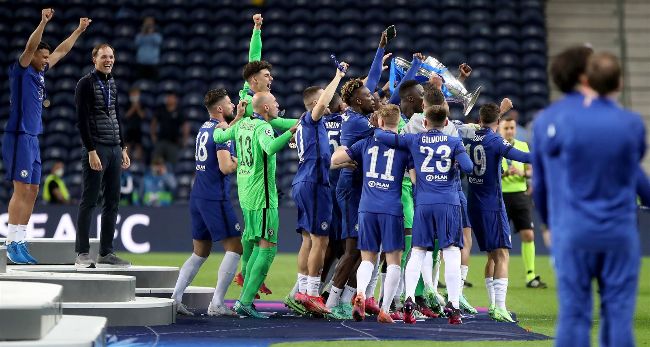
Triumph in Porto, one year on from final anguish
KING LOUIS DETHRONED
In August 2009, newly-promoted Bundesliga club Mainz needed a quick fix. Former coach, the Norwegian Jorn Andersen, had just led Die Nullfunfer back to the top flight, but a 2-1 loss in the first round of the DFB-Pokal against fourth-tier Lubeck, coupled with an ongoing spat about playing style, saw him axed five days before the league kick-off.
That quick fix was Tuchel.
“We were shocked to lose Jorn on the eve of a new campaign,” former Mainz defender Nikolce Noveski, who made 348 appearances for the club between 2004 and 2015, recalls to FFT. “We’d been very successful under him. He’d led us to promotion, so we were really disappointed.”
With survival at all costs the season’s target, hiring a manager with no senior experience could have sparked a dressing room riot. Yet Tuchel’s demeanour put minds at ease. “Our first impression of Thomas was that he was very competent,” says Noveski.