STONE COLD CRAZY
With In Rock, Deep Purple Mark II carved their place in hard-rock history. And it’s largely thanks to the maniacal mind and guitar mastery of Ritchie Blackmore.
BY RICHARD BIENSTOCK
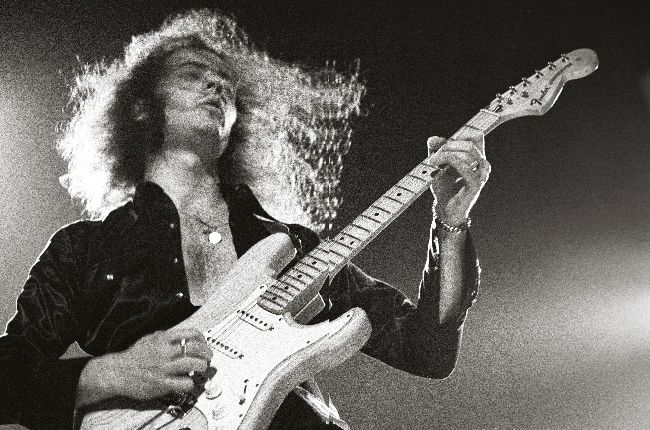
Ritchie Blackmore onstage with Deep Purple, February 1973
IAN DICKSON/REDFERNS/GETTY IMAGES

IAN DICKSON/REDFERNS/GETTY IMAGES
“FOR THE FIRST PROBABLY FIVE YEARS OF DEEP PURPLE — ’70 TO ’75 — I DID HAVE THE LOUDEST AMP IN THE WORLD”
— Ritchie Blackmore
DEEP PURPLE IN ROCK
is many things, but subtle is not one of them. Within literally seconds of listening to it, you’re blasted by Ian Paice’s frantic, slippery drums, Jon Lord’s braying organ and, of course, Ritchie Blackmore’s indelible guitar riffing and loopy tremolo flourishes. Along the way, singer Ian Gillan references and rearranges rock’s DNA (“‘Good golly!’ said little Miss Molly / When she was rocking in the house of blue light!”), punctuating his Little Richard and Elvis Presley–inspired lyrics with ridiculously piercing and forceful shrieks and wails. For that matter, the frenzied rhythm, developed by bassist Roger Glover, emulates Jimi Hendrix’s “Fire.” From there, we’re through two verses and choruses and on to bearing witness to a classic Lord–Blackmore organ-guitar battle. And we’re only a minute into the record.
The song we’re listening to is called “Speed King,” and it’s a wild and breathless launch to In Rock. It’s also completely in line with what ensues over the next 40 minutes or so. From the snaky, metallized grind of “Bloodsucker” to the breakneck gallop of “Flight of the Rat,” the monolithic guitar-organ groove of “Into the Fire” and the thundering “Hard Lovin’ Man,” the album is a relentless sonic juggernaut, its massive and over-the-top sound reflected in both the album title and the Mount Rushmore–aping cover art. In fact, the only moment where Purple drive the music with anything less than the pedal fully floored is the 10-minute epic “Child in Time.” And given the fact that Gillan refuses to sing this one onstage anymore due to the practically inhuman vocal demands (there’s also an explosive, elongated Blackmore solo that many consider one of his best), this might be the most intense track of all.
“I USED TO HAVE QUARTER-INCH [VIBRATO] BARS MADE FOR ME BECAUSE I’D KEEP SNAPPING THE NORMAL KIND”
— Ritchie Blackmore
“If it’s not dramatic or exciting, it has no place on this album,” Blackmore once said of In Rock, and we’d be loath to disagree. There’s nary a moment on the record that isn’t a full-on white-knuckled experience. But we’d also add the word heavy to the first part of Blackmore’s statement. Because even today, 50 years after its original release, In Rock is a testament to just how intense (and, per Ritchie, dramatic and exciting) guitar-based rock and roll can be. A half-century ago? It sounded positively revolutionary.
The album arrived at a turning point in popular music culture. The ’60s were, chronologically and spiritually, over. Woodstock had given way to Altamont, the Beatles were on the brink of breakup, and free love and the hippie dream had morphed into something darker and less idealized. There were heavy bands, but many of them — Cream, Jimi Hendrix, Vanilla Fudge, Blue Cheer — were either dissolved or on their last legs.
Into this moment stepped three British acts — Led Zeppelin, Black Sabbath and Deep Purple — that would push hard rock to new extremes and influence the generations of bands that were to follow. By 1970, Zeppelin had established themselves as the preeminent hard-rock outfit, with two blockbuster albums under its belt and a third brewing that would delve more deeply into folk and acoustic roots. Black Sabbath, meanwhile, were crafting a doomy and downtuned sound that, paired with Ozzy Osbourne’s desperate wail and an overall exaggerated evil atmosphere, established the template for heavy metal going forward.