Fretboard fluency
Martin Goulding brings you the last in the current Fretboard Fluency series, and introduces the symmetrical Half-Whole Diminished scale.
Martin Goulding
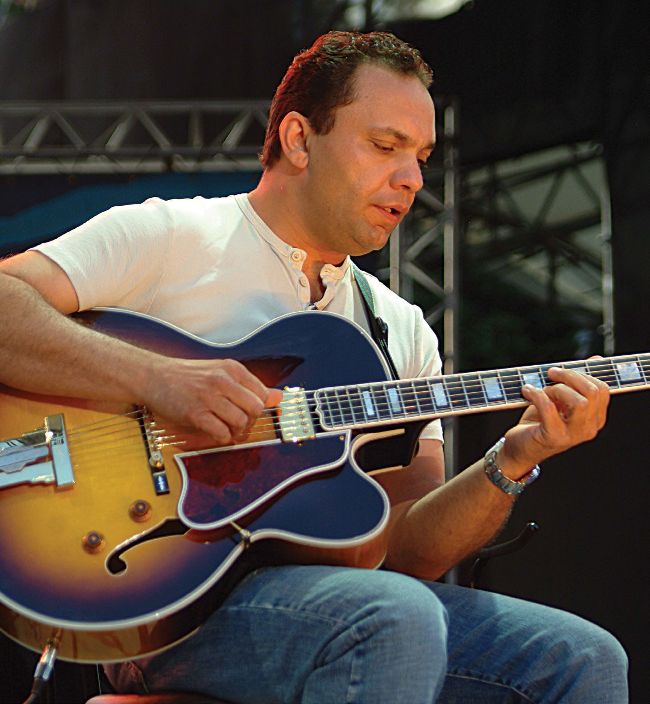
Biréli Lagrène: French jazz genius who uses the Half- Whole Diminished
The Half-Whole Diminished scale is commonly applied to functional progressions such as the II-V-I as well as over non-functional Altered Dominant vamps that include the natural 6th/13th degree, and where the scale will give a darker and more atmospheric sound. It’s a common sound in jazz, fusion and progressive modern rock and metal styles.
This eight-note symmetrical scale is built from consecutive half and whole tones (steps), with the formula: R b2(b9)-#2(#9)-3-b5-5-6-b7. Before we move on - a quick note regarding the formula. It may be more common to see this formula written to include the #4th degree, and which gives a more logical numerically ordered set of intervals, due to the fact that this scale is more often applied over Altered Dominant chords, or Dominant chords that feature alterations to the 2nd(9th) and 5th degrees. But I’ll be referring to this interval as a b5th. Similar to the Superlocrian mode which we’ve studied in the past, the b3rd degree will be referred to as a #2nd (or if higher than an octave a #9th) as the scale also includes the Major 3rd.
Within this formula, we can identify our basic Dominant 7th chord type (R-3-5-b7) along with the b9th, #9th and b5th degrees which may be added to heighten tension over the V7 chord when used in functional harmony (where the V chord usually resolves to the Major or Minor tonic chord a 4th higher). We can also identify the colourful natural 6th degree which sets the Half-Whole Diminished scale apart from other Altered Dominant scales such as Phrygian Dominant and Superlocrian which include the #5th (b6th) degrees. This means that the Half-Whole Diminished scale is our first choice when improvising over Altered Dominant chords that contain the natural 6th degree, such as the V13b9. Within the intervallic formula, and similar to the Phrygian Dominant mode that we’ve been studying recently, we can also identify the Diminished 7 and Dominant 7b9 arpeggios.