Harmonic Minor on the V
In part two of his new series Jens Larsen examines the Harmonic Minor scale as a rich source of melodic choices over the V chord.
Jens Larsen
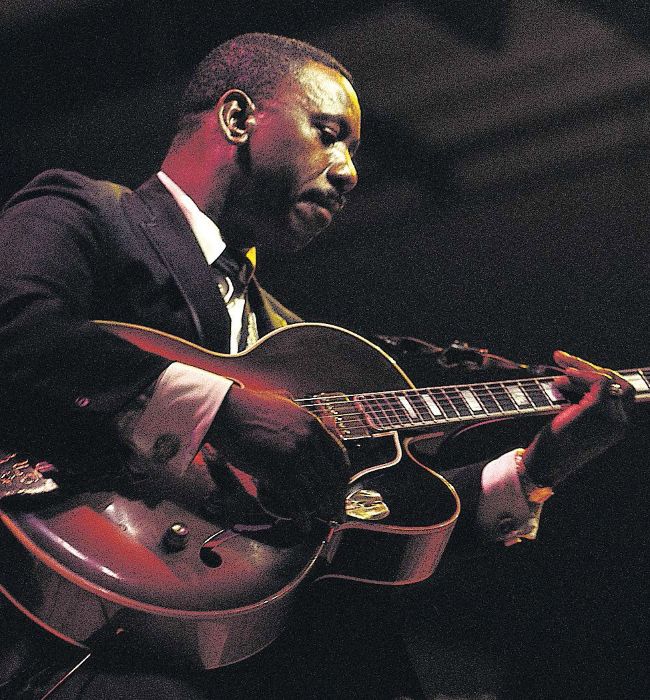
Wes Montgomery: one of the finest jazz musicians that ever lived
The jazz standards we play today were, for the most part, written by classically trained composers in the tradition of the Romantic period. Therefore many of the harmonic devices found in jazz are not dissimilar to those used by Chopin, Schubert and Berlioz, so listening to classical music alongside jazz can teach us a lot about both styles. Historically, jazz is the combination of the aforementioned Romantic classical harmony with an added twist, achieved by mixing it with the blues. Of course both jazz and blues are African-American artforms that originated in the Southern states during the early part of the 20th century.
All the examples in this lesson will be in the key of F Major where the Dominant V chord would normally be a straight C7. However, we are going to ‘borrow’ the Dominant 7th chord from the F Harmonic Minor scale and extend it so it becomes C7b9b13.
When playing over the V chord in a 12-bar blues, or in a typical jazz chord progression (say the C Dominant chord in the key of F), most guitarists tend to think ‘C Mixolydian’ (the fifth mode of the Major scale). However, because we will be playing over an Altered Dominant chord rather than a straight C7 (the aforementioned C7b9b13), we can access some rather more interesting sounds. Some people call this scale C Mixolydian (b9 b13), but Phrygian Dominant is a more common (and perhaps more logical) name as it has the same intervals as Phrygian, but with a Major 3rd instead of the flattened 3rd that’s normally found in the Phrygian mode.