CARRY ON!
CO-FOUNDING GUITARIST RICHARD WILLIAMS TALKS KANSAS: THE HIGHLIGHTS, THE HITS, THE CLASSIC GUITAR SOLOS AND THE NEW ALBUM, THE ABSENCE OF PRESENCE
BY JOE BOSSO, PHOTO BY PAUL NATKIN
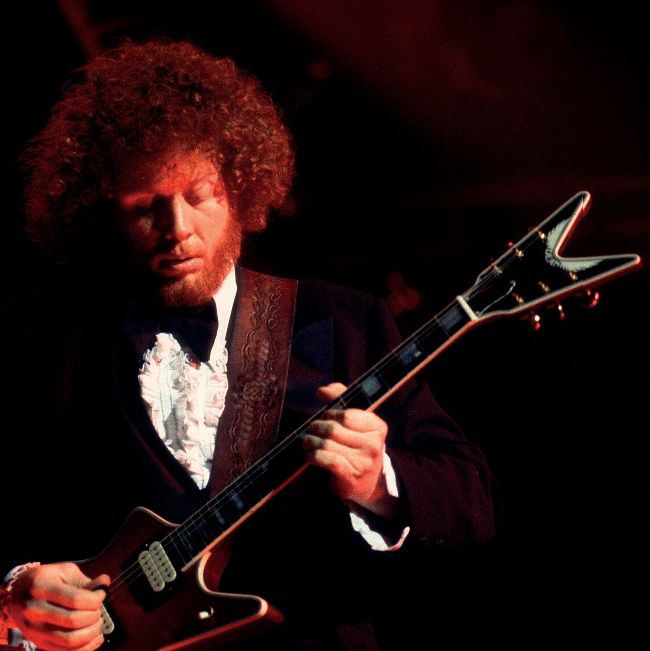
Kansas guitarist Richard Williams (with his Dean Cadillac) performs in Chicago in October 1980
PAUL NATKIN/GETTY IMAGES
MENTION
THE BAND KANSAS TO THE average listener, and he or she will instantly name two classic rock staples: “Carry On Wayward Son” and “Dust in the Wind.” “Oh, sure, those are the big ones,” says guitarist Richard Williams, who co-founded the progressive rock outfit back in 1970. “I could let it get to me and go, ‘Hey, we’ve got a whole body of work,’ but that would be a waste of time. Those are the songs that brought us to the table. Without ‘Wayward
Son’ and “Dust in the Wind,’ we wouldn’t be around today.” Williams recalls how in 1976, with the band deep in debt to their record label and facing an uncertain future after their first three albums (Kansas, Song for America and Masque) stiffed, they approached the recording of their fourth album, Leftoverture, with a sense of impending doom. “It was a pretty dark time. We were bleeding money pretty seriously,” he says. “We were signed to Kirshner Records, and our benefactor, Don Kirshner, could have easily said, ‘Guys, it’s been fun, but you need to find another record company.’ We needed a hit, and thank goodness we came up with ‘Carry On Wayward Son.’ It saved us so we could go on. And then we had ‘Dust in the Wind.’ Those songs exploded and our worlds changed forever.”
Kansas were in a unique position in the mid Seventies. Not only did they represent the last trace of progressive rock on AM playlists that were suddenly ruled by disco, but they were also one of the very few purveyors of American prog, period. “Not to sound pompous, but we pretty much gave birth to American prog bands,” Williams says. “What’s amazing is, we did it pretty sneakily. We were playing bars in Topeka, doing all the hits of the day — Motown, the British Invasion, all that — but we really wanted to do our own material. So we’d slip in one of our own tunes and tell the crowd that we were playing the B-side of ‘Smoke on the Water.’ We’d stretch songs out and go crazy, and the people loved it. It became our thing.”
Of the seven current members of Kansas, only Williams and drummer Phil Ehart remain from the original crew. Singer Steve Walsh, who ended his on-and-off association with the band in 2014, has been replaced by two co-lead vocalists, Billy Greer and Ronnie Platt, who double on bass and keyboards, respectively. Williams’ longtime guitar foil Kerry Livgren, who also served as Kansas’ chief songwriter, split in 2000, and in his place is New Jersey picker Zak Rizvi. “It feels like a different band sometimes because we’ve got a bunch of newer faces,” Williams says, “but at the same time, it feels like the original band because we’ve got seven guys who really love to perform and create. Back in the day, we let money and business get in the way. This bunch of guys just wants to make music.”