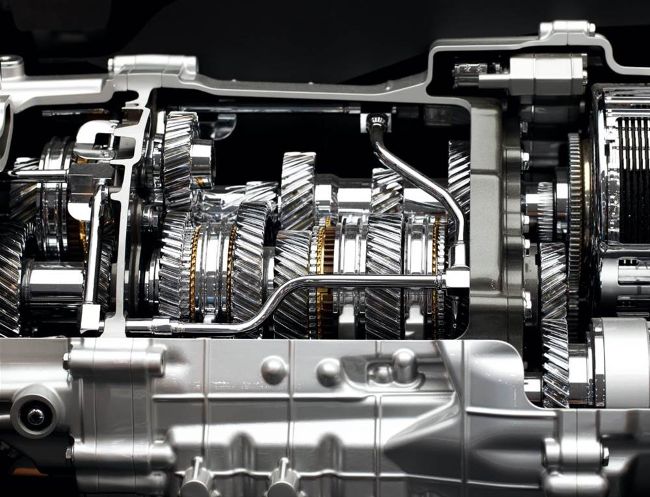
Gearboxes are complex and intricate, and they’re crucial parts of every car
T he gearbox is one of the building blocks of the modern car, and unsurprisingly it’s also one of the most complex bits of hardware inside any vehicle. Despite all of that, the principle stays simple. A car’s engine connects to its crankshaft, which rotates thousands of times per minute. That’s too fast for the wheels, so gears convert the power to speeds the wheels can handle. They use interlocking teeth, connecting a small, fast-moving cog to a larger gear with more teeth, and that larger cog rotates at a reduced speed.
Did you know?
Metal gearboxes are smelted at over 700 degrees Celsius
Lower gears have larger cogs, allowing the engine to deliver a lot of force without the car moving quickly, ideal when you’re driving slowly or uphill. Higher gears deliver more speed rather than torque, which is great for smooth motorway driving. Lower gears deliver more power, while higher gears supply more speed – but you’ve got to shift your way up through the gears to reach
those high speeds. Most cars have at least five gears, giving drivers finer control over power and speed. Gearboxes have been around for a while: the first modern manual transmission was de monstrated by French inventors Louis
François René Panhard and Émile Levassor in 1894, and Louis Renault improved upon the design in 1898. In 1928 Cadillac introduced a synchronised system to make gear changes smoother. Automatic gearboxes appeared commercially in the 1940s, and now they’re just as popular as manual gearboxes.
Beneath all of this, gears remain an ancient concept. Their use has been discovered in 4th-century China and in ancient Greece, and the world’s oldest working clock has been using gears to tell the time in Salisbury Cathedral since 1386. Gears might be old, but they’ve clearly stood the test of time, and they’re still integral to every car you see on the road.
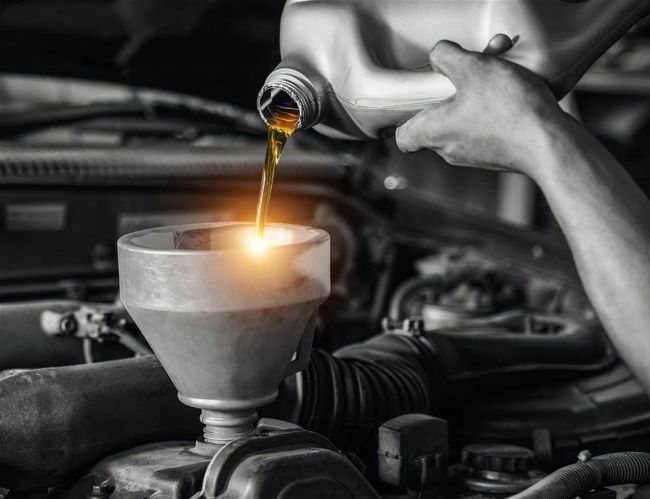
Automatic gearboxes rely on hydraulic fluid, so they need to be topped up to keep them working well
AUTOMATIC MAGIC
Automatic gearboxes are as popular as manual gearing in many countries, and they’re far more prominent in the US. They’re favoured because drivers don’t have to mess around with clutch pedals and gear sticks. Most automatic cars use a torque converter system. Instead of using the clutch to separate the engine from the gearbox to change gears, the car relies on gearbox oil to transfer energy from the input shaft to the gears, and in turn the wheels. Computers determine exactly when gears need to be changed. This allows for smooth gear shifts and easier driving, and automatic gearboxes are often more efficient than their manual counterparts.
DID YOU KNOW? Automatic systems are so popular in the US that you can only buy a handful of cars with manual gearboxes
GEARING UP FOR THE FUTURE
Most cars still use manual or automatic gearboxes, but some new vehicles have modern continuously variable transmission (CVT) or dual-clutch systems. CVT is a type of automatic gearbox, but differs from conventional hardware in one key way. Instead of using normal gears, where drivers can feel the transitions, CVT gearboxes have a cone-shaped design and a system of pulleys to create a smooth transition up and down the car’s power range. It’s an efficient system that’s often used in hybrids. Dual-clutch systems are often found in semi-automatic cars – the inclusion of two clutches means cars can preselect gears, which means you get incredibly quick gearshifts. You’ll also find this system on high-performance cars and vehicles with gear-shifting paddles on the wheel. Manual gearboxes aren’t immune from innovation either. Volkswagen has produced a new manual gearbox called the MQ281 that massively improves efficiency and reduces emissions.
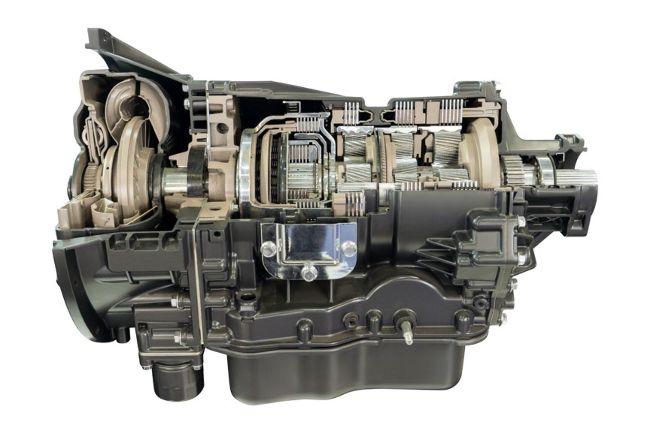
Automatic gearboxes are often even more complex than conventional manual gear systems
INSIDE TRANSMISSION
Manual gearboxes are common and complex. Here’s how the gearbox works in most cars
5 FACTS ABOUT GEARS
1 EARLY STAGES A Canadian engineer called Alfred Horner invented the first automatic transmission in 1923, but he used compressed air rather than hydraulic fluid, so the system lacked power.
2 NATURAL SELECTION Gears are also present in the natural world. A tiny bug called Issus coleoptratus has gear-like structures on its legs with interlocking teeth, used so it can jump in straight lines.
3 GEAR CHOICE From 1930 to 1950, it was quite common to find cars with ‘preselect’ gearboxes. Drivers would have to choose their gear before pressing on the clutch pedal.
4 PADDLING Formula 1 cars use semiautomatic sequential gearboxes with eight forward gears and one reverse gear inside their carbon-titanium gearboxes. Fully automatic systems have been illegal in F1 since 2004.
5 HEAVY MACHINERY One of the world’s biggest gearboxes can be found inside a wind turbine: it produces 10,000kNm of torque and weighs 86 tonnes.