NUCLEAR EXPLOSIONS
The explosive science behind the biggest human-made blasts on Earth
WORDS SCOTT DUTFIELD
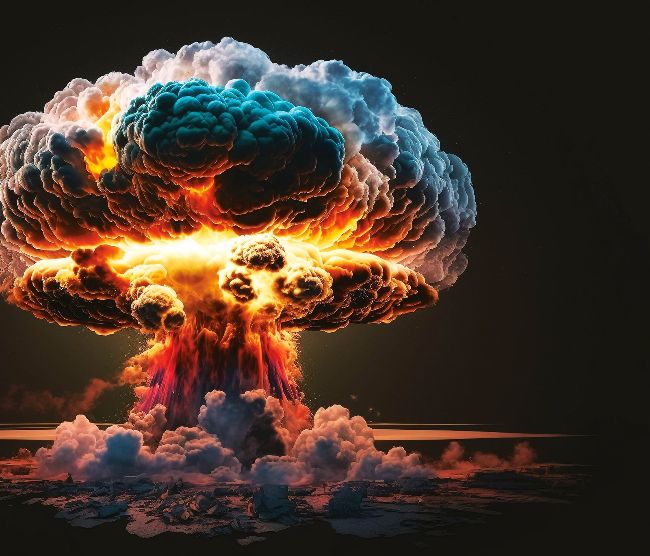
© Alamy
DID YOU KNOW? 92 per cent of the buildings in Hiroshima were destroyed in the 1945 nuclear strike
Nuclear explosions are the biggest of the big, the most energetic and the cause of some of the most catastrophic calamities in recorded history. The incendiary force of nuclear technology is unrivalled by any other form of human-made explosive. Destructive methods such as trinitrotoluene, better known as TNT, create violent outbursts as a result of chemical reactions between combustible elements, such as carbon and oxygen. Nuclear explosions, on the other hand, occur at an atomic rather than a molecular level.
The term ‘nuclear’ refers to the nucleus, or centre, of an atom, which is made up of particles called protons and neutrons. Different elements have different atomic structures, with some having more or fewer particles in their nucleus. When the number of protons and neutrons in the atoms of an element are balanced, they are considered stable. However, for some elements, the nuclear weighing scales are unbalanced. As part of nature’s attempt to balance the scales, atoms of radioactive elements, such as uranium, expel extra protons and neutrons in a process known as radioactive decay. The rate at which an element sheds these particles is referred to as radioactivity.
Did you know?
Nine countries have either nuclear fission or fusion weapons
The road to understanding the explosive potential of nuclear energy began in the late 1780s, when a German chemist named Martin Klaproth discovered uranium. Since then, scientists have uncovered its physics and chemistry, including Pierre and Marie Curies’ discovery of uranium’s radioactivity in 1896, Lise Meitner and Otto Frischs’ work on splitting the atom in the early 1900s and Ernest Rutherford’s famous fusion experiments in 1934. Over a century’s worth of research has uncovered that the explosive power of nuclear energy comes in two forms: fission and fusion. Although both can lead to immensely powerful explosions, they work in different ways.
A nuclear explosion by way of fission occurs when heavy radioactive elements such as uranium or plutonium are bombarded with a subatomic particle called a neutron. This bombardment causes the element’s atoms to split, releasing energy and more neutrons as a result. A fission chain reaction in which more neutrons bombard more atoms culminates as a massive explosion, which can either be exploited for generating energy or used in warfare – an atomic bomb.