A DEVIL OF A TALL TALE
Gregory Kulon looks back at the 1941 fantasy classic, The Devil and Daniel Webster, in which 19th-century New Hampshire farmer regrets making a pact with Satan, then enlists famed orator Daniel Webster to extract him from his contract!
Making deals with the Devil has been a part of folklore for centuries among many different countries and regions. Probably the most famous historical version of selling one’s soul to the Prince of Darkness is the Faust legend which dates to the 16th century in Germany. The earliest versions of the legend are some of the darkest, as Faust’s desire for knowledge leads him to sell his soul into eternal servitude for several years of access to answers and, of course, other pleasures.
This tale would take an entirely American twist on October 24, 1936 with the publication of the short story “The Devil and Daniel Webster” in the Saturday Evening Post. Written by Stephen Vincent Benét, the story takes the form of a tall tale of years past and includes a real historical character in a courtroom battle with the devil. Not surprisingly, the story would have a more comforting, optimistic conclusion than the legend of Faust or other traditional narratives.
As an American tale, it would also have more of a focus on money and power rather than Faust’s quest for knowledge.
Benét was born in 1898 in Fountain Hill, Pennsylvania, immersing him in small town life and the rural stories that are told there. That said, it became clear at an early age he was talented, attending Yale University and writing for its humour magazine, publishing his first novel at age 17, and traveling in his early 20’s to France to broaden his experiences on a fellowship.
Daniel Webster was a real person, born in New Hampshire in 1782. A lawyer with a talent for persuasive speaking, Webster rose quickly into politics. He served as a US Congressman, Senator, and two separate terms as Secretary of State. In the 1840s when the story is set, Webster was largely expected to have the Presidency in his future. A strong supporter of the Union, his name includes some controversy today in his support of positions that were seen as compromising his values on fugitive slave rights to allow continued expansion of the country, slavery free, to the West.
Benét’s story would mainly avoid any controversy of the character. The story unfolds in the style of a folk tale told over a fire or in a darkened room at night. It describes Webster in the typical tall tale terms. “They said, when he walked the woods with his fishing rod, the trout would jump out of the streams right into his pockets, for they knew it was no use putting up a fight against him.”
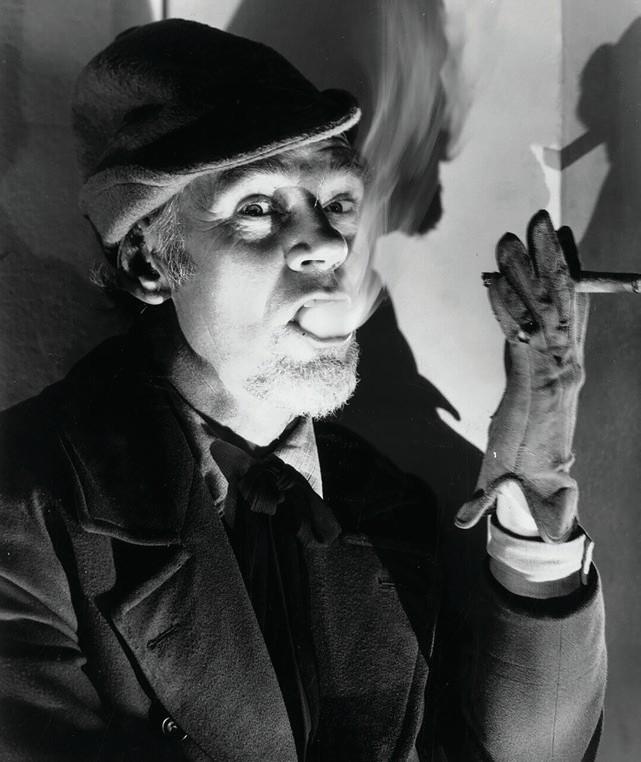
This image: Walter Huston as Mr. Scratch
The plot revolves around Jabez Stone, a struggling New Hampshire farmer with a family who has more than his share of bad luck. One day in a fit of frustration, he vows that he would sell his soul to the devil for two cents. As might be expected, the Devil pays a visit to take him up on the offer, leading to several years of prosperity and growing influence for Jabez. However, as his allotted time is running out, Stone asks Webster to plead his case to break the contract hanging over him. It is up to Webster to save Jabez’s soul in front of a hand-picked jury of the damned, all infamous men who had played a part in the development and history of America. Before long, Webster realizes his own soul is at stake with this judge and jury.
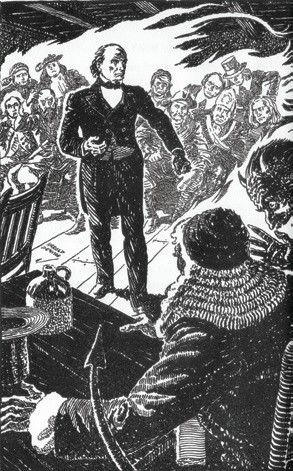
Illustrations from the first edition book printing of the story by Harold Denison
With the exception of Webster himself, the story seems more focused on the style of the telling than its characters. Although Jabez has a wife and children in the short story, they are really nothing more than a stage setting. Also lacking for such a story is any outside sexual interest which is prevalent in Faust and most of the other legends of this type.
One memorable detail from the story that stands out occurs in an encounter with Jabez and Scratch, one of the names the Devil likes to go by in New Hampshire. Jabez notices a small, moth-like creature that Scratch wraps into a handkerchief. The moth had been pleading for help from Jabez in a low, terrible whining voice, but one that was recognizable as that of a townsman, Miser Stevens. It is then that Jabez hears the church bells tolling, and realizes they are announcing Stevens’ death.