Better...Stronger...Faster...
Legendary writer/producer Kenneth Johnson shares his memories of working on The Six Million Dollar Man with Infinity’s Ernie Magnotta...
Steve Austin, astronaut, a man barely alive. Gentlemen, we can rebuild him. We have the technology. We have the capability to make the world’s first bionic man. Steve Austin will be that Man. Better than he was before. Better... stronger… faster.
The Six Million Dollar Man aired on ABC-TV between 1973 and 1978.
Based on the popular 1972 novel Cyborg by Martin Caidin (Marooned, Buck Rogers: A Life in the Future), the show starred Lee Majors (The Big Valley, The Fall Guy) as low-key, likeable and all-American Steve Austin, a United States astronaut and Air Force Colonel who, during a test flight accident, loses both legs, his right arm and his left eye. Oscar Goldman (played by movie and television veteran Richard Anderson, Forbidden Planet, Compulsion, The Night Strangler), who is the Director of the OSI (Office of Scientific Intelligence), orders scientific genius Dr. Rudy Wells (Martin E. Brooks, Night Gallery, Knots Landing) to perform an emergency operation on Steve which will replace his missing parts with bionic technology. The cost of this top secret operation is six million dollars. Now a cyborg possessing incredible strength, speed and enhanced vision, Steve, as payback for his lifesaving surgery, reluctantly accepts assignments for the OSI that no normal secret agent could possibly survive.
Along with six made-for-TV movies, the extremely entertaining series had a total of 99 one-hour episodes. The show, which quickly became a pop culture phenomenon, would emphasize Steve’s bionics through distinctive sound effects and by filming the action scenes in slow motion, while the memorable theme music was provided by talented composer Oliver Nelson (Columbo, The Blues and the Abstract Truth).
Recently, I once again had the pleasure of speaking with one of my heroes, writer/producer/director Kenneth Johnson. Known for creating iconic television shows like The Incredible Hulk (1977-1982), writing and directing the popular miniseries V (1983), and producing the well-done, but unfortunately short-lived TV series Alien Nation (1989-1990).
Johnson began his amazing career writing and producing episodes of The Six Million Dollar Man and he is responsible for creating some of the most beloved and remembered episodes of the entire series’ run. Right off the bat, Johnson introduced the character of Steve Austin’s childhood sweetheart, Jaime Sommers (played by the supertalented and extremely likeable Lindsay Wagner, Scruples, Nighthawks), who becomes The Bionic Woman after a
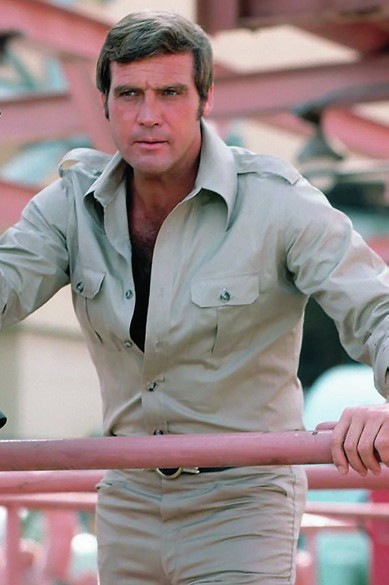
Kenneth Johnson
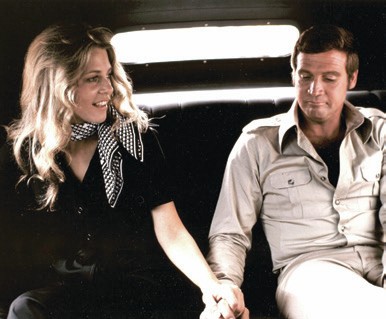
Lee Majors and Richard Anderson
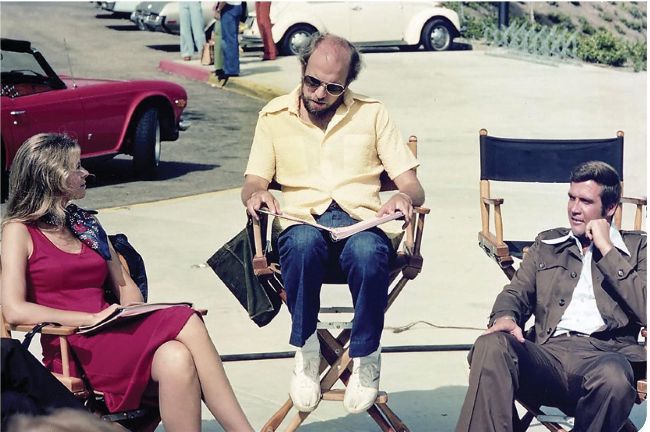
The above central image is a nice behind-thescenes shot of Kenneth Johnson going through a script with Lindsay Wagner and Lee Majors
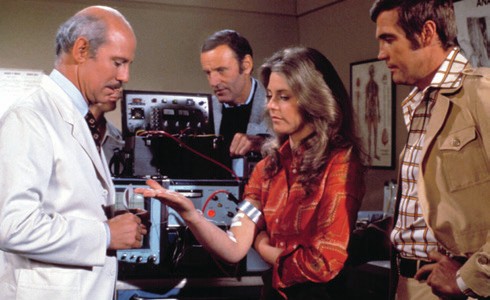
This spread: Lindsay Wagner’s first appearance on The Six Million Dollar Man (1974) was supposed to be her last role honouring her contract with Universal. However, public reaction to her was so strong that she was offered her own series.
skydiving accident leaves her with injuries similar to Steve’s. (Jaime became so popular that she was granted a television series of her own which was created and produced by Johnson and ran for three seasons—two on ABC and one on NBC—between 1976 and 1978.) Johnson is also the man responsible for creating the iconic character of Bionic Bigfoot by writing two, two-part episodes which absolutely thrilled 1970s television audiences and continue to do so to this day.
To celebrate The Six Million Dollar Man’s 50th anniversary, Johnson not only went into great detail about the creation of these two well-loved characters, but he also happily spoke to me about subjects such as the fun and the hardships of writing and producing this classic television show, what he feels he brought to the series, and working closely with Lee Majors, Lindsay Wagner, Richard Anderson, Andre the Giant, and Ted Cassidy.
I can’t believe that it’s been 50 years since The Six Million Dollar Man first aired.
Honest to God, Ernie, it feels like an eye blink. It feels like I was just there yesterday.
You started working on the show during its second season, right? Tell me how you got involved.
What happened was I was trying to get my foot in the door as a writer because Steve Bochco, my college classmate who was working at Universal, convinced me that writing was the best way to get my foot in the door as a director, which is what I really wanted to do. I never thought of myself as
a writer. I’d never really done it. Directing is so much more fun. But I discovered that I could write and Steve and my other great pal, Stephen Cannell, were really great help in getting me writing gigs.
Cannell gave me a couple of writing assignments for the series Adam-12 where he was the story editor at the time. This was just before he had created Rockford Files. He also gave me my first directing job at Universal on one of the Adam-12 episodes. And Steve Bochco had a couple of short-lived series going, so he gave me a couple of scripts on those which was helpful. But beyond that, I was writing a lot of spec screenplays, most of which are still on my shelf, Ernie. (Laughs) And there was one very funny script about stuntmen which Steve gave to Harve Bennett who was a big executive producer at Universal. He was doing these great miniseries like Rich Man, Poor Man and he had also been brought on to produce The Six Million Dollar Man in its first season. They had already done three pilot films before they realized that they shouldn’t put Lee Majors in a tuxedo and try to make him an imitation James Bond. (Laughs). Lee told me, “That was really dumb, Kenny. I’m a shit-kicker. They should have just said I came from Oklahoma, man.”
Anyway, Steve gave the stuntman script to Harve Bennett and Harve really liked my writing. They had just started lining up scripts for the second season which really was their first full season. Season one was a mid-season replacement in which they had only done maybe thirteen shows. Now, they were looking at the daunting task of twenty-two or twenty-three more. So Harve was really scrambling for scripts and he asked me to come up with some ideas. I sat down in his office and one of the first things I suggested was The Bride of Frankenstein. And that’s where the character of Jaime Sommers, the Bionic Woman, originated.