THE MAG FROM AUNTIE
Alistair McGown concludes his histories of TV-centric comics with a look back at BEEB, 1985’s short-lived BBC rival to Look-in...
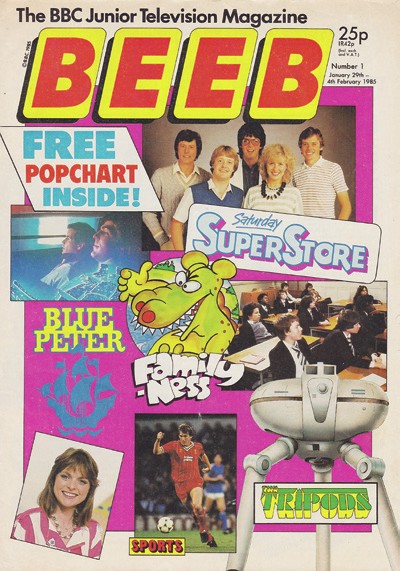
The very first issue of BEEB contained a free pop chart and promoted the BBC’s new Tripods sci-fi series, serialised in comic strip form
In the world of mid-80s TV-related comic magazines, Look-in, the Junior TV Times, was the only show in town. At the end of 1984 the weekly, now almost 14 years old, was drawing a huge readership of 270,000 with its canny mix of pop pin-up features, exciting TV action picture strips and info on ITV’s latest shows.
Having seen off DC Thomson’s TV TOPS earlier in 1984 [see Infinity 70], the perennial TV Comic, a pioneer in TVrelated publishing since 1951, had also closed in June 1984, briefly giving Look-in a monopoly in this arena. But TV Comic’s publishers Polystyle plotted a high-profile comeback and within seven months had an ambitious new title on the news-stands.
BEEB, borrowing the long-standing term of endearment for the BBC, went on sale on Tuesday 29 January 1985, at last offering a direct rival to Look-in, being devoted to BBC programmes for younger people in exactly the same way Look-in was based around commercial television output.
Polystyle had published not just TV Comic, but other short-lived offshoots in the previous decade including Countdown, TV Action [for both, see Infinity 39] and Target [see Infinity 45]. All had been edited by the hugely experienced Dennis Hooper, now aged 50. Art editor of legendary Gerry Anderson title TV Century 21 in the 1960s, Hooper joined Polystyle to launch Countdown in 1971, eventually becoming the firm’s managing editor in 1979 and editorial director from 1980.
BEEB had far better production values than TV Comic, with good quality printing and plenty of colour, and as a comic-magazine, rather than a pure comic, was aimed at a slightly older, more sophisticated readership. Intended to enjoy a more direct connection to the BBC than the arm’s length licensing of previous TV properties, BEEB relied on a core of factual programmes for its non-pop music feature material, chiefly the Children’s BBC magazine shows Blue Peter, Saturday SuperStore and nature programme Wildtrack.
Polystyle’s owners, the Argus Press, ploughed £250,000 into an advertising launch across 6000 UK poster sites. They were also banking on free cross promotion on the BBC’s airwaves, and the first issue was trailed on Saturday SuperStore by a recordbreaking gigantic 1500-piece jigsaw of the debut issue’s cover measuring 45 x 70 feet, hand-painted by Redhill sign writer Peter Drapans.
Buoyed by such onscreen plugs, the first issue, accompanied by a free pop calendar wall-chart, sold an impressive 160,000 copies and all seemed set fair for a long-running success.
SCHOOL STRIPS
BEEB’s picture strip roster comprised the same six TV-related titles for almost all of its brief life. Tough-edged school soap Grange Hill, recently embarked on its eighth season on TV, was a key property in the BEEB mix. Grange Hill strips had previously appeared in various IPC annuals and specials and short-lived weekly School Fun [see Infinity 62] but BEEB’s comic adventures were brand new. Drawn by John Armstrong, known for girls’ titles Tammy and Misty, the perhaps unlikely writer was Pat Mills, more famous for seminal work in 2000AD and early instalments of Marvel’s Doctor Who strips in 1979-80; Armstrong and Mills had collaborated on Misty’s Carrie-like Moonchild in 1978.