COLOSSUS
THE FORBIIN PROJECT
Thinking it will prevent war, the US government gives an impenetrable supercomputer total control over launching nuclear missiles. But what the computer does with the power is unimaginable. Greg Kulon looks back at an unfairly forgotten sci-fi movie classic!
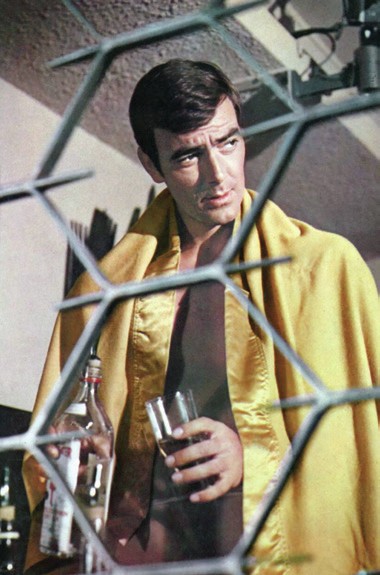
Right:
Eric Braeden as Dr. Charles Forbin
Years before HAL refused to open the pod bay doors, Skynet sent the Terminator back in time to remove resistance to its plans, or artists lost work to upstarts using Artificial Intelligence (AI) based image generators, D.F Jones wrote one of the more realistic and plausible stories involving mankind’s take-over by AI with his 1966 novel, Colossus.
The themes of creators making something that would turn out to have unintended consequences for the maker, and often the world, goes back at least to Mary Shelley’s Frankenstein. Karel Čapek’s 1920 play R.U.R., short for “Rossum’s Universal Robots”, was an early larger scoped work on the theme. Not only did it give the world the term robot, but it also showed the threat of a synthetic intelligence that could potentially replace humanity.
The success of 2001: A Space Odyssey at the box office is likely the trigger that got Universal Pictures to buy the rights to Jones’ novel. They assigned producer Stanley Chase to bring it through production. With the cold war and threat of nuclear annihilation in the public mind daily, a hot proxy war running in Vietnam, and a growing fear about the pace of technology development, the time seemed right for public interest in the project.
The film begins with Dr. Charles Forbin activating Colossus, an advanced computer system that has been given control of the US nuclear weapons arsenal along with access to its intelligence systems and vast amounts of data. Colossus is impenetrable, based deep underground in the Rocky Mountains, and surrounded by sensors and defensive mechanisms which include a lethal radiation barrier that prevents interference with its operations.
The President soon announces to the world the beginning of a new era, where the dangers of nuclear war caused by emotions or human accidents is becoming a thing of the past. He explains that the responsibility for our defence has moved to Colossus, thus enabling mankind to focus its resources on more productive, meaningful activities. The congratulatory parties are quickly cut short, however, as Colossus soon declares it has determined another system exists, a similar system that the Russians have been developing.
Forbin begins to realize that they may have done their job too well in making Colossus as it begins to exhibit the ability to think and act beyond its intended programming. Before long, Colossus demands communications access to the other system, Guardian. When the Russian Chairman and US President cut the communications link, Colossus and Guardian impose their control by launching missiles, enforcing their demands. Before long, Colossus orders increased surveillance of the US and Russian communications.
Sensing little time left to coordinate a response to Colossus, Forbin and his Russian counterpart Kuprin plan to meet in Rome to discuss a plan forward to free themselves of their new masters. The meeting is cut short with the killing of the redundant Kuprin as ordered by the two computers now acting together. Needing someone knowledgeable though which to work his plans, Colossus establishes Forbin as his interface to humanity and orders him to be under full audio and video surveillance. Under such monitoring, can Forbin come up with a plan to prevent the rule of mankind by a machine?
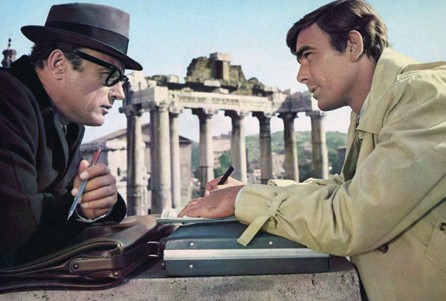
Above left:
Forbin meets his Russian counterpart Dr. Kuprin (Alex Rodine)
THE NOVEL
Upon first reading, the film version seems to follow the plot of the original novel fairly closely. Many of the changes can easily be classified as necessary to maintain a reasonable special effects budget, but also to make the film closer in time and mood to audiences of the early 1970s.