Around Loch Torridon
“No matter what life throws at me, there’s always the hills.” Cameron McNeish
by Vivien Martin
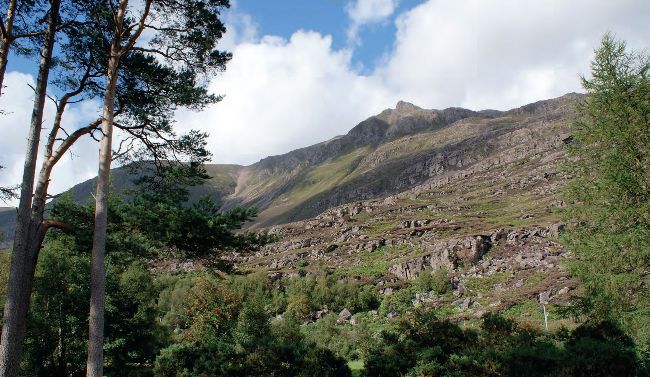
Liathach, Torridon
Poor road access, coupled with a rapid reduction in ferries, was to be the fate of much of the Western Highlands
A HEARTFELT sentiment from Cameron McNeish and one that’s shared by many people. The pull of Scotland’s mountains can be very strong. The Torridon hills in Wester Ross draw visitors from all over the world. Visitors who come from hundreds, even thousands, of miles away to experience them. Liathach, Beinn Alligin, Beinn Eighe: sandstone giants of incalculable age, rising effortlessly from a bedrock of ancient Lewisian Gneiss. How fortunate we are to have ready access to this magnificent wild and rugged landscape. But was this always the case? Not in the slightest!
If you approach Torridon from Shieldaig (featured in iScot issue 64), you’ll travel smoothly and easily along the southern shore of Upper Loch Torridon. Yet there was no road here until 1963. In fact before then, there were only two points of motor access to Torridon. One was at Shieldaig (from Lochcarron), the other at Torridon village (from Kinlochewe). But not only were those roads grossly inadequate, they didn’t even join up. Such poor transport links played a significant role in fueling depopulation in the Highlands. Communities can only survive and thrive if transport links are good. But poor road access, coupled with a rapid reduction in ferries, was to be the fate of much of the Western Highlands. And was a recipe for disaster.
It can be hard for us to imagine just how cut-off from friends and family you could be. For example, it’s only seven miles from Shieldaig to Torridon village, yet before the new road was built the only way of getting there by road was to travel twenty-seven miles east to Achnasheen and then twenty miles back west. The alternatives were a seven mile hike over a rough hill-track or going by boat the length of Upper Loch Torridon. Both these latter routes were used to carry coffins to the burial ground at Annat, but both were precariously weather-dependent. In more recent times, the lack of access made secondary schooling difficult and left others with no choice but to leave the area to find work elsewhere. Those who stayed had a hard job making a living as crofting fishermen. It’s not surprising the new road was so welcome and brought hope to the people of the district.
The alternatives were a seven mile hike over a rough hill-track or going by boat the length of Upper Loch Torridon
Ease of access can make us impatient. We expect to get from A to B quickly. But it’s not that long ago that patience and perseverance were the order of the day! In her book, Torridon Highlands, Brenda Macrow writes of her six-month stay at Inveralligin in 1952. Simply getting there is quite a journey. From Edinburgh she takes the train to Inverness. The following day the train to Achnasheen, where she boards the bus, “a gray shooting-brake.” A pause at the Kinlochewe Hotel, then on again the length of Glen Torridon to reach the village of Fasag. It’s far from being a comfortable journey. At Fasag there’s an hour’s wait for another bus, but the wait is at least a respite from the “interminable jolting which has been our lot since leaving Kinlochewe.”
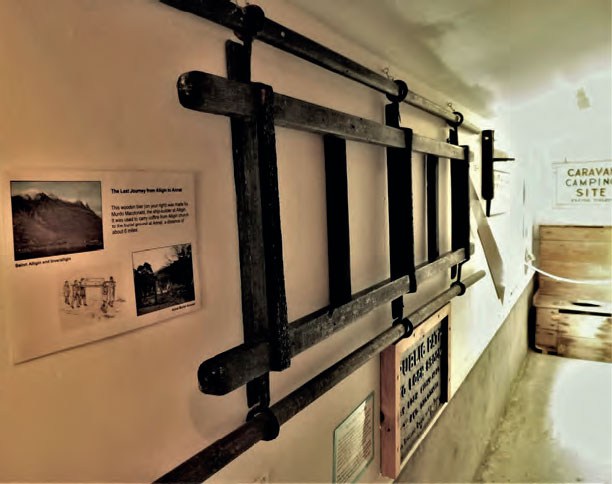
The Last Journey from Alligin to Annat. Wooden bier made by Murdo Macdonald shipbuilder at Alligin, to carry coffins from the church in Alligin to the burial ground at Annat, a distance of about six miles (Gairloch Museum)