A Pilgrim People
”Not all who wander are lost” J.R.R. Tolkien
by Vivien Martin
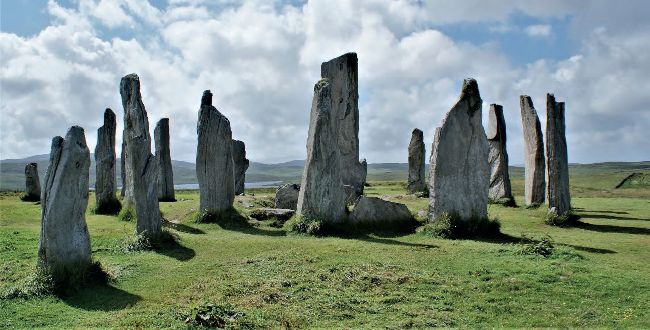
Ancient standing stone at Calanais, Isle of Lewis
It’s said that “curiosity killed the cat.” But I don’t go along with that at all. In fact, I believe it’s the exact opposite, a lack of curiosity, that ‘kills’ us. That stultifies our minds and our imagination. That closes our eyes to the possibilities of life and blunts our ability to have a vision of better things.
Indeed, I think the Book of Proverbs hits the nail on the head when it says “Where there is no vision, the people perish.” Whether a vision for our individual lives, or for our nation, it’s curiosity that leads us to ask questions and explore different ways of doing things. It’s curiosity that leads us to say “What would Scotland be like if…?” Without curiosity people wouldn’t explore or experiment. Without curiosity early man wouldn’t have gone to see what was over the next hill or on the other side of that wide blue ocean.
Without curiosity scientists and doctors wouldn’t have made the breakthroughs they have. Curiosity fuels our imagination and opens our eyes to connections we hadn’t noticed before. Just think of the complex process required to turn cocoa beans into chocolate and you have to marvel at human ingenuity!
People have always been curious, trying to find ways – and the words – to understand the world around them. To explain the seasons, the floods and famine, as well as the bounty and beauty of the world. To understand why the world is the way it is.
We also need curiosity to question the structures that control and confine our lives. And that includes the political and social structures that all too often divide our world unfairly. In the 1960s a Norwegian sociologist, Johan Galtung, wrote about peace and conflict, coining the term ‘structural violence’ to describe those social institutions that, whatever their original intent, ultimately harm people. We can see that very clearly in disastrous state setups like universal credit or the rape clause. State-sanctioned legislation that serves to demean and invalidate the most vulnerable in our society. Structures that impose limitations which deaden, or attempt to erase, our hopes for our ourselves and our communities
Whether a vision for our individual lives, or for our nation, it’s curiosity that leads us to ask questions and explore different ways of doing things
Curiosity makes you want to understand what’s happening and why, and we’re in a bad place if asking questions is deemed to be dangerous or divisive. Where there is no vision, the people perish. Curiosity, asking questions, exploring different ways of doing things, is vital to that vision. And thankfully curiosity is a very strong human trait! Sometimes our curiosity is triggered in the most subtle of ways. Have you ever noticed the way in which certain places elicit a strong response in us? Have you ever walked into an unfamiliar room yet felt instantly at home? Or walked an old track and felt a shiver go up your spine and wondered what events left their mark here? Sometimes it’s the memory of tragedy and suffering that seems to imbue a landscape. Think of all those blood-soaked battlefields or abandoned settlements, steeped in anger, misery, terror and pain. Yet there are other places that seem to be centred on very different memories, and evoke very different feelings in us. Places where peace and stillness prevail. Places that have become regarded as special, holy sites. Sacred because of their closeness to something other, something spiritual. The thin places of the Celts and often places of pilgrimage. Always intangible, yet definitely there, the power of place can be very strong indeed.