Carved in Stone
Fowlis Wester, Forteviot and the Southern Picts
by Vivien Martin
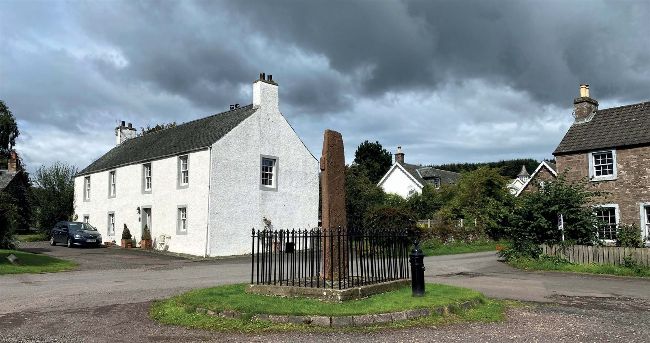
Fowlis Wester and its Pictish sculptured cross-slab
IF THE 8TH CENTURY sculptured stone at Fowlis Wester is anything to go by, the Picts were a dapper looking bunch. The men, that is, as they’re the ones depicted on the carved stones we see today.
With razor-sharp beards and nifty topknots, they’d be quite at home amongst today’s hirsute males. And as both mirrors and combs feature among the symbols carved on Pictish stones, they must have been of great importance to be given such lasting status. Cool dudes, indeed!
With razor-sharp beards and nifty topknots, they’d be quite at home amongst today’s hirsute males
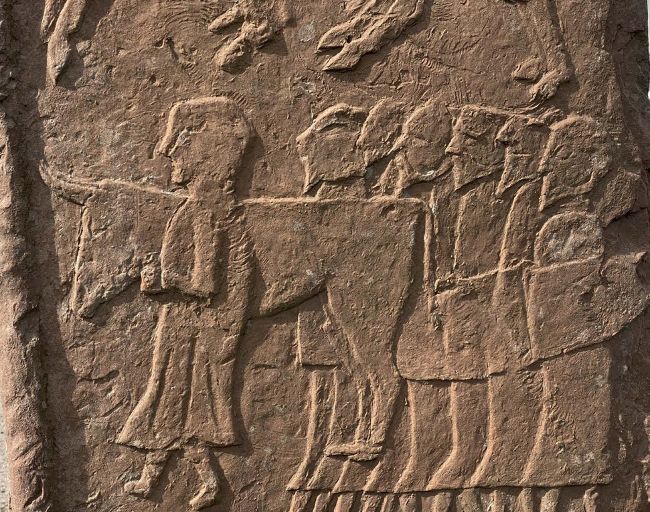
Seven men and a cow! A unique Pictish carving
Fowlis Wester is a tiny place, just off the A85 between Crieff and Perth. Yet the presence of a towering Pictish cross-slab, as well as a second beautifully sculpted stone, and an ancient church, show it’s been a place of significance in the past.
The taller stone (complete with a unique carving of a procession with a cow!) was brought into the church in 1991 to protect it from the elements and a replica erected in the village centre. The carvings on the smaller of the two stones are in excellent condition: chiefly because it had been buried in the walls of the church since the 1300s and thereby spared the ravages of Scottish weather! It was only rediscovered during renovations to the church in 1927.
Fowlis Wester was once on the main route to Perth and surrounded by smaller farming settlements. The area is now sparsely populated, but back then it had a busy inn, with Highland drovers filling the village as they herded their cattle to the markets further south. According to a guide to Fowlis Wester Kirk, the village once had a cattleselling tryst as important as that of Falkirk. Changed days indeed.
The present village sits on the east-west axis across the heart of Scotland, and on an ancient route between Dál Riata in the west and Pictland, with its southern powerbase at Forteviot, in the east.