Guide to: biomass boilers
Looking for a sustainable, low-carbon alternative to mains gas? Nigel Griffiths explains the benefits and costs of these wood-fuelled heating systems

This BioWIN 2 boiler from Windhager has a manuallyfed pellet hopper.
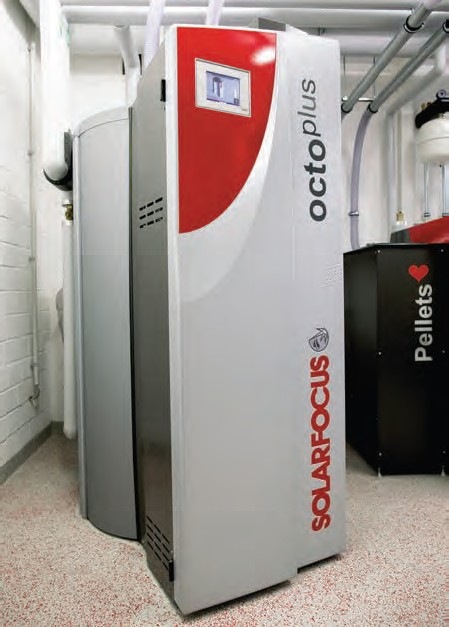
Winner of the 2015 Build It Award for Best Heating Product, the OctoPlus biomass boiler from Solar Focus is available in 10kW, 15kW and 22kW outputs and features an integrated buffer cylinder that stores the heat created
Burning wood in order to heat your home may seem like a pretty old-fashioned idea, but modern technology has brought us way past the traditional open fireplace. In the right circumstances, today’s bells-and-whistles biomass boilers can rival gas in terms of running costs – and potentially deliver a sustainable, low-carbon solution for your project.
What is biomass?
In basic terms, it’s any form of plant matter that can be burned to deliver heat. In practice, it’s normally wood. This could simply be logs, or it might be a wood waste product (such as chips or pellets) that’s specifically suited to fuelling boilers. In addition, energy crops such as miscanthus are grown explicitly for use as a fuel – but these are typically only used for large-scale commercial operations as opposed to domestic installations.
If it is sustainably sourced, wood is considered to be a carbon neutral fuel, as the CO2 emitted from burning it is slightly less than the amount the tree absorbs as it grows. Unlike fossil fuels, wood produces negligible amounts of sulphur dioxide or nitrous oxides – so burning it does not contribute significantly towards the problem of acid rain.
In order to remain carbon neutral as a fuel, it’s important that the wood is grown as close as possible to where it’s used and that the local distribution system is efficient. Timber harvested for this purpose must be replaced, so that the equivalent CO2 emitted during combustion is reabsorbed by the new trees as they grow.