Beginner’s gouache
Part 1 Practise essential gouache techniques as Murray Ince begins a short series on how to paint with this versatile and colourful medium
LEARNING OBJECTIVES
Practise gouache techniques, including dry brush and layering
Learn a painting process step by step
How to paint layers in a landscape
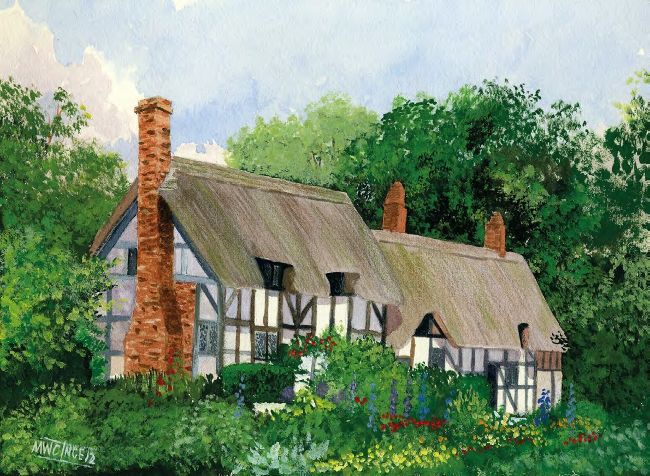
Ann Hathaway’s Cottage, gouache, 7x10in. (18x25cm). The sky in this painting was put in using the gouache considerably thinned down, almost as I would with watercolour. The rest of the painting, however, was completed with the paint thinned only a very little.
Gouache is a lovely medium with which to work and has a surprisingly long history. It is very similar in use and look to egg tempera and casein. Egg tempera’s pigments are bound with egg yolk as you might expect, whereas casein is precipitated from milk. The binder is made by dissolving the resulting casein in an alkaline, usually lime, ammonium carbonate or borax, which is then added to the pigments. There are very subtle differences in these three media, but probably the most important difference is that, over a short period of time, both casein and egg tempera becomes waterproof. Gouache does not become waterproof when dry so needs mounting and framing under glass in the same way as you would with watercolour. The advantage of this is that the paint can be re-activated by dampening, allowing for more subtle blending techniques.
The binder used in the manufacture of gouache is gum arabic, the same as in watercolour, the major areas of difference being that the particles of pigment in gouache are larger than those in watercolour and there is significantly more pigment in gouache. This, coupled with the addition of an extender, usually precipitated chalk, helps to make the paint much more opaque.