Watercolour
Part 3 Tim Fisher demonstrates how he uses French vermilion Sennelier watercolour in his paintings
LEARNING OBJECTIVES
n How to work with French vermilion
n Practise colour mixing with just three colours
FRENCH VERMILION
Colour mixing with a primary palette of three colours – French vermilion, French ultramarine blue and primary yellow – is simple and straightforward.
1 Mix all three colours evenly together and a neutral tint or grey results. As French ultramarine blue and French vermilion are opaque and primary yellow is semi-opaque, a dense, dark colour can be produced. Varying the proportions of the colours can result in a neutral colour with a bias towards the most plentiful pigments used.
2 I mixed French ultramarine blue and primary yellow to create green then added a small amount of vermilion to create a darker green. I added it to the top of the square and let it bleed into the wet paint. 3 Combining two primary colours results in pleasing secondary colours. French ultramarine blue and French vermilion combined make violet.
4 French vermilion and primary yellow make orange.
5 Primary yellow and French ultramarine blue make a range of greens, depending on the proportions of yellow and blue mixed.
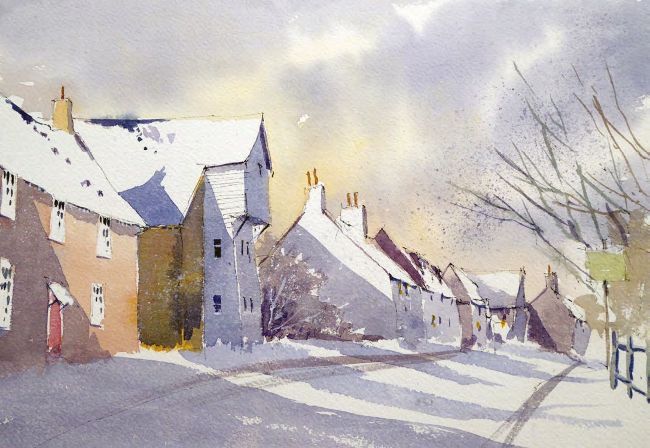
Mill Street, St. Osyth, Sennelier watercolour on Sennelier 140lb Rough watercolour paper, 9x13in. (23x30cm)
When working with watercolour, I try to restrict myself to as few colours as possible, usually around seven when I’m working in the studio. It’s very easy to be influenced by other artists, books and emerging colours to end up with an unwieldy collection of unwanted tubes of paint. By being frugal with colour choices you can become familiar with each one and understand how it will react with other colours within your palette. Fewer colours also help to keep costs down, which means you could perhaps invest in Artists’ quality rather than Student watercolours.