SIDE BY SIDE
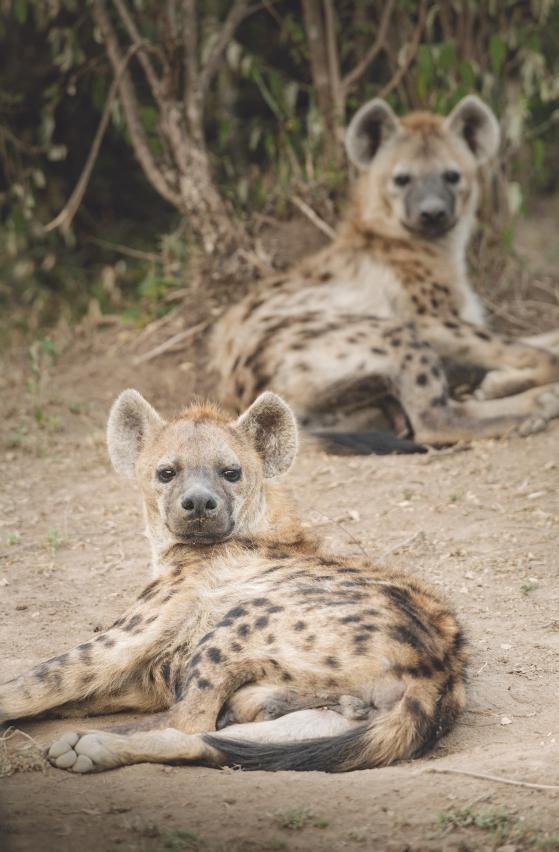
Hyenas have a teddybear look but an unsavoury reputation. Left: A baby elephant rests at her mother’s feet. Previous pages: A herd of elephants make their way across the conservancy
The elephant is so close I can hear him chew. His powerful jaws crunch effortlessly through a mouthful of whistling thorn acacia, a tree with the texture of a medieval mace. Another member of the herd is grunting with exertion as she uproots a bush, a procedure being copied – rather ineffectually – by her tiny baby. His stubby legs aren’t long enough to manage the twist-and-pull method his mother deploys to devastating effect, and eventually he slumps to the ground to rest his head on her giant toenails. I arrived in the Mara just hours ago, but feel far from weary myself. Being so near to the group is electrifying, and I sit in the Land Cruiser in awed silence, watching as they make their way across the plains, the sun burning high in a cloudless sky. The collective noun for elephants is a ‘memory’, and these will be forever etched on mine.
After half an hour the elephants start to move on, leaving a trail of destruction in their wake: fallen tree trunks, branches stripped of leaves. Some of the 30-strong herd brush against the bonnet, others clip the 4WD’s tyres with their tails as they swish away flies. It is tempting to reach out to touch a wrinkled hide, but this would be foolish. Though Dumbo, Babar, Elmer and their ilk have established elephants as benign in our collective imagination, they are among the most dangerous animals in the African savannah. In Kenya alone, they have killed over 200 people in the last seven years.
Nevertheless, in the Mara Naboisho Conservancy, a large conservation area that borders the more famous Masai Mara National Reserve, animals and humans are obliged to coexist. The Conservancy is made up of 50,000 acres leased from Maasai landowners, who pursue their traditional occupation as herders while receiving an income from fees paid by visitors staying at tented camps, like Hemingways Ol Seki. This money ensures that the wildlife that tourists come to see remains protected, and guides – like Raffy Rotiken – play an important role in maintaining this delicate relationship. ‘Here, you grow up knowing how dangerous the animals are. But learning how to approach them in a car, and making sure they feel comfortable with you being so close, that’s something that comes with experience,’ says Raffy. ‘An elephant could knock down a house like it is nothing. The Maasai villages have a lot of trouble with them.’
One such village is Rakwa, home to around 60 people. As Raffy pulls up, a group of women gather to sing in welcome. He tells me the song used to be performed for warriors returning from a successful lion hunt, but as the Maasai no longer kill these animals it’s been repurposed. The children of the village observe our arrival curiously, watching the scene from the doorway of their huts. ‘Here, one village is one family,’ Raffy says. The Maasai are polygamous, each wife and her children occupying a separate dwelling, and constructing them from mud is considered women’s work. One of the huts in Rakwa is clearly a cut above the rest, with taller, smoother walls and a neat door made from three wooden planks. It belongs to a woman in her sixties called Noolamala. Her husband, a village elder, died some years ago, but she retains the status of her position as first wife.