PS5 Pro vs. PC
Why the console wars aren’t really a thing
Yes, we’re talking about games consoles again. Don’t worry, we know this isn’t Maximum PlayStation, but with the arrival of the PS5 Pro and its radical shift upwards in pricing, it got us thinking about our console cousins and just how wildly different the two ecosystems are.
As you’ll have surmised from our build feature, trying to cram that much power into such a small form factor in the PC enthusiast’s world, at an identical price, is both impractical and kind of impossible.
Sony might have bumped that $ figure skyward, but in many ways, it’s justifiable, certainly if the GPU is as close to the RX 7600 XT as we suspect it may be. Nonetheless, we’re not about to tell you it’s that clear-cut, that the console finally has the upper hand, and we should all be swapping our custom-built $3,000 systems for a PS5 Pro, keyboard, and mouse. Nope, we’re going to take a deep dive into the PS5 Pro, have a look at where it’s at, how it’s taking advantage of modern-day tech to hit that 8K marketing buzzword, and figure out where the future of gaming is going.
–ZAK STOREY
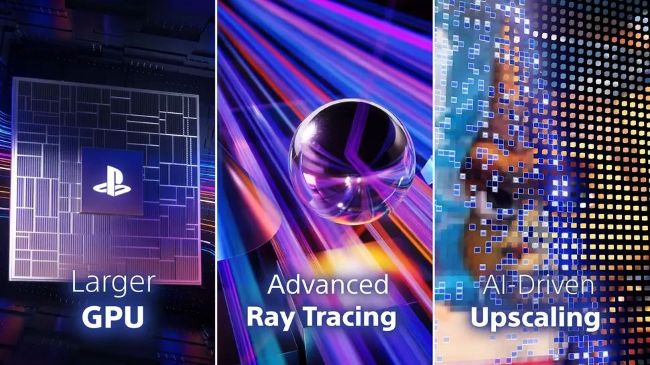
Sony is introducing its own upscaling in the form of PSSR, probably a derivative of AMD’s FSR.
The enigmatic PS5 Pro
The PS5 Pro has finally been announced. It’s technically the third iteration of the PlayStation 5, following the initial launch in 2020, and its pseudo-refresh, the PS5 Slim, that landed in 2023.
Here’s the thing, though: We haven’t had a huge amount of information about the plucky new Pro console, only a few snippets of data from press conferences, all of which are rather ambiguous. So, what are the top-line specs?
Well, we know the CPU is probably the same, as there was no mention of any upgrade in the official announcement, so that’s likely an AMD Ryzen Zen 2 chip. That’ll come with eight cores, 16 threads, and a 3.5GHz clock speed. This is a custom model, built specifically for the PS5, based on the Ryzen 3000 series processors. It’s not too dissimilar from the Ryzen 7 3700X, just with a lower TDP and clock speed.
The SSD has been replaced, with the Pro removing the pitiful 825GB PCIe 4.0 drive and replacing it with a larger 2TB model. It’s worth noting that read speeds remain the same, and to be fair, you could add additional faster storage to the old PS5 anyway, bumping that internal spec up. Shared RAM is reported to be identical, with the Pro housing 16GB of GDDR6 clocking in at 448GB/s total memory bandwidth.

The only major differences between the Pro and the PS5 seem to be an updated GPU and more storage.
The question of graphics
Then there’s the GPU, the beating heart of a gaming console, what it needs to really drive its performance home. But here’s the kicker: The PS5 Pro supposedly supports 8K gaming. Sony has promised that in its marketing materials. Still, detail is incredibly sparse on the GPU in question. As a result, we have to speculate quite heavily on this one as to what it actually is.