Masterclass
Flying Scotsman’s many outfits
Looking at railways in detail
Knowing which mechanical and cosmetic permutations are correct for your own modelling era can be a minefield when it comes to Flying Scotsman. Thomas Bright presents a handy guide to a century of change, while Nick Brodrick and George Dent highlight suitable Hornby models for each period.
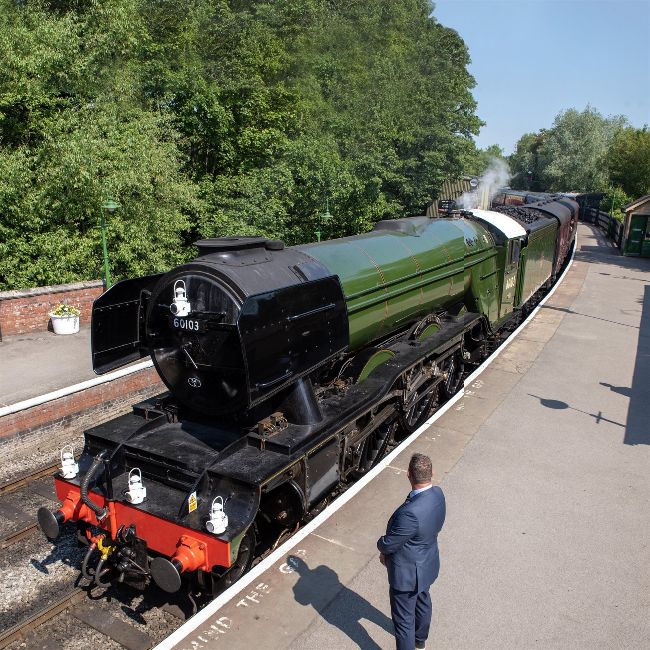
Another new, if subtle, look for
Flying Scotsman…
This time (summer 2023) it sports a white cab roof, painted for its Royal Train duty between York and Pickering, where it is seen arriving with King Charles III on board on June 12.
NICK BRODRICK
For Flying Scotsman, nothing ever stays the same.
This chameleon‐like locomotive has carried multiple numbers, colours, types of boiler, chimneys, domes and tenders, not to mention myriad changing fixtures and details.
Even in its centenary year it has looked a little different, being adorned with a white cab roof for the first time in British Railways green livery. That was for its starring appearance at the head of the Royal Train. Emulating Stratford depot’s tradition for royal workings, the white roof was a symbolic touch, rather than a slavish historical nod to anything that the celebrity ‘A3’ did in its 40-year working life.
Indeed, authenticity is a topic seldom far from the minds of the locomotive’s massive army of followers.
The most dramatic of all ‘Scotsman’s’ many looks must be its American garb with – literally – all the bells and whistles, plus lamp and cowcatcher. As anathema as that condition might seem to conservative British taste, it’s noteworthy how it has made several appearances in ready-to-run form. Despite the ‘A3’ now being owned by a museum, authenticity remains a thorny subject. That’s because the multiple modifications it has undergone, including (pivotally) in private ownership mean that, without major surgery, Flying Scotsman cannot actually be faithfully presented in any livery combination.
“
The last place you should look for accurate prototypical information is the locomotive itself!
”
What you see, therefore, is the best compromise; with the locomotive carrying 1960s smoke deflectors to prevent smoke drift from the softer double-chimney exhaust, and BR green was chosen over the arguably more recognisable LNER Apple green, despite being paired with a corridor tender representing a much earlier period.
To comply with the challenges of still running No. 60103 on the main line, it now sports modern fittings, like air brakes (instantly recognisable by the twin air pipes hanging below the bufferbeam with red and yellow valves) and some of the gear for the Global System for Mobile Communications – Railway, or GSM-R, is mounted in a chunky box on the top of the tender.
Ironically therefore, the last place you should look for accurate prototypical information is the locomotive itself! That is, unless, you are modelling the locomotive as it is today…
What follows is a comprehensive guide to the alterations that have been made to ‘Scotsman’ over the years to ensure your model is as accurate.
We say model, because for some, one Flying Scotsman isn’t enough, which explains why six collectable versions are being released by Hornby in ‘OO’ in its retro ‘Dublo’ range this year alone.