THE ALCHEMISTS
Forty years ago, a band of Glaswegian art-rock misfits located the formula for a spectacular transformation. From base metals, SIMPLE MINDS alchemized New Gold Dream (81-82-83-84), an album which would change their lives for ever. As they prepare to reconstruct the album live in Edinburgh, Jim Kerr, Charlie Burchill and their former bandmates tell KEITH CAMERON the whole miraculous tale, from psychedelic experiences in the Scottish countryside, to redneck run-ins in Saskatoon... “Worldwide on the widest screen!”
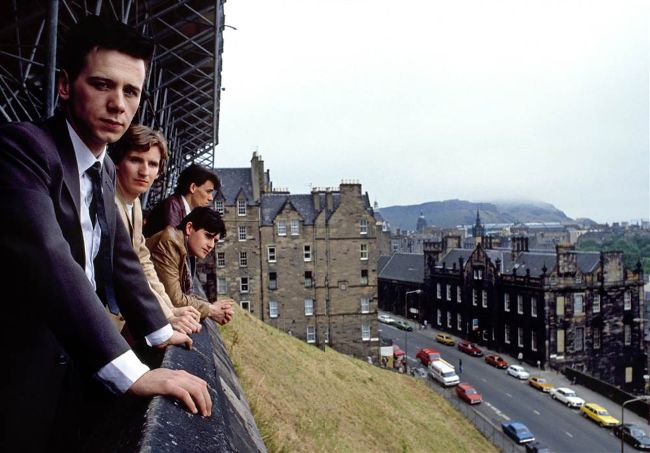
And then there were four:
Simple Minds looking to the future on Castlehill, Edinburgh, August 1981 (from left) Jim Kerr, Derek Forbes, Charlie Burchill, Mick MacNeil.
Photograph: JILL FURMANOVSKY
ON SEPTEMBER 25, 1982, Simple Minds’ fifth album entered the UK chart at Number 6 – the band’s first Top 10 record. It was titled New Gold Dream (81-82-83-84), an auspicious, slightly pretentious declaration of context, momentum, and intent: there’s where we’ve been, here’s where we’re going.
“On previous albums I still felt we were a student band,” says Jim Kerr. “In the sense we’re still learning from those who inspired us – Magazine, Bowie, Roxy and so on, using base metals to get to our own thing. With New Gold Dream, it was like: this is us now. These are our times.”
One week later, Glittering Prize, a celestial union of iridescent melody, assertive rhythm and Kerr singing about “the price of lost love” and “the attraction of fame”, sashayed into the Top 20 singles chart like a counterfactual ’80s Roxy Music that Eno had never left. Six months earlier, their Top 20 debut had “promised you a miracle”; here now was the assured confirmation of Simple Minds’ metamorphosis from agitated art-rock misfits into heralds of an aspirational new pop.
Soon enough, however, the sublime bowed to the ridiculous. Having prefaced their album’s release with some low-key UK gigs, by the time New Gold Dream charted, Simple Minds were touring Australia and New Zealand. The journey home included 12 dates in Canada, with Vancouver and Toronto bookending an eastward slog across the endless prairies of Alberta, Saskatchewan and Manitoba.
“The tour from hell!” chuckles drummer Mike Ogletree. “There was a truck accident, one of the drivers broke his collarbone, my drums were strewn across the highway…”
Late October found Ogletree in a Saskatchewan hotel room watching a documentar y about the Ku Klux Klan – aweird premonition of the subsequent gig in a local student union hall. “Because it was a Halloween party, these people had turned up dressed as Ku Klux Klan,” he says. “We were basically in redneck countr y. Jim freaked out at the promoter: ‘Get them the fuck out of here.’”
Bassist Derek Forbes remembers grabbing the promoter by the throat. “He was dressed as Dracula. His head’s down, he’s ashamed, people in the audience thinking Ku Klux Klan outfits were a good choice for a band with a black drummer. I says, ‘You’re an asshole.’ He says, ‘Hey – Imight be an asshole, but I’m the biggest asshole in Canada.’”
In Jim Kerr’s recollection, the promoter later tried to make amends by driving the singer, guitarist Charlie Burchill and Ogletree across town in search of entertainment, only to be stopped by the police.
“Fortunately we weren’t carr ying anything, but Dracula got hauled off. We’re left by the side of the road in Saskatoon. That was one of my favourite tours. A fucking disaster, but riveting. Dodgy equipment, dodgy trucks, a bus that was 20 years out of date. It was a Heart Of Darkness feeling: ‘If we can get to Toronto, we’ll be saved.’”
Toronto on November 7 would be Mike Ogletree’s last act as a member of Simple Minds. Upon returning to the UK, at a band meeting in London’s Columbia Hotel he was told he wouldn’t be on the forthcoming UK tour. “They said, ‘We’re using Mel Gaynor from now on. Here’s 500 bucks and a ticket to Scotland.’” Ogletree laughs. “It was good-natured – because of me, y’know, I’m an easy-going guy. And I loved the band. Still do.”