The Big Twang
THE HOT NEWS AND BIZARRE STORIES FROM PLANET MOJO
Inspirational guitar great Duane Eddy left us on April 30. Phil Alexander bids farewell.
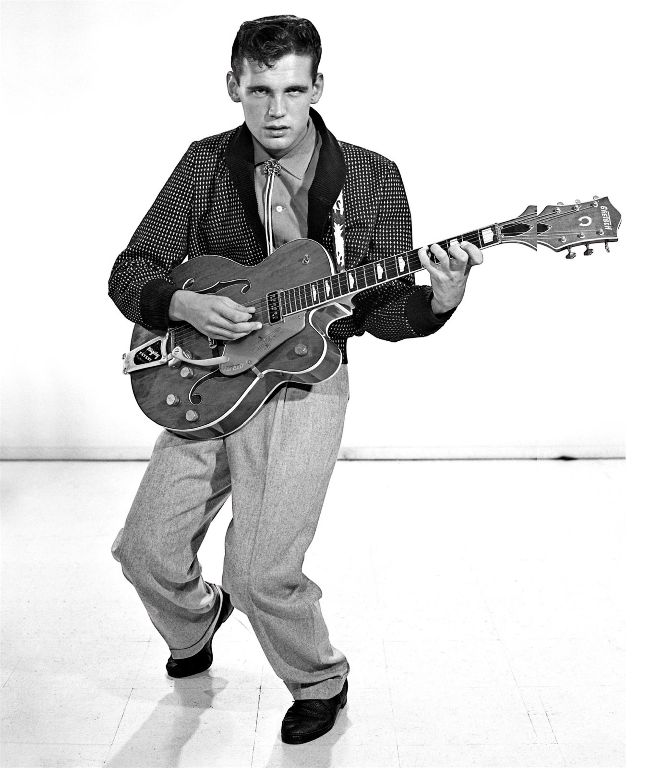
Guitar hero: Duane Eddy in New York in 1958, his breakthrough year; (opposite) Eddy with his signature model Gretsch G6120DE guitar, London, June 11, 2010.
Getty (2)
COOLIDGE, ARIZONA. 1951. A fresh-faced 13-year-old New York-born kid has just arrived in town. He takes his bike, goes exploring and discovers a new world: the desert. “I fell in love with all that space,” recalled Duane Eddy when we spoke in 2010. “You could just lose yourself out there. Musically, I could always go out into the desert with just an acoustic guitar and write a song.”
Eddy, of course, is known for that sound. The ‘twang’, as it became known. You can hear it on classic tracks like Rebel Rouser, Ramrod, Cannonball or any of the 45s from Duane Eddy’s early hot streak – the unmistakable bending of those reverb-soaked, low-end strings delivered in a classy, unadorned manner against a driving rhythm designed for maximum impact. Listen a little closer to a deeper cut like the beautiful First Love, First Tears, for example – and you hear something else: a faraway melancholy which hails straight from those desert ride-outs.
Born on April 26, 1938, in Corning, a small town in upstate New York, Eddy discovered his father’s acoustic guitar in their basement at the age of “five or six”, going electric a few years later when his aunt bought him an Electromuse lap steel and an amp. Soaking up pop and big band music, he soon discovered his own heroes in the form of country pioneers Hank Williams, Jimmie Davis and Gene Autry. At the age of 12 he made his first radio appearance when he and his classmates performed a version of ’40s classic, The Missouri Waltz, on a local station.