REAL GONE
When The Storm Broke
Leader of north Wales rockers The Alarm and beyond, Mike Peters left us on April 29.
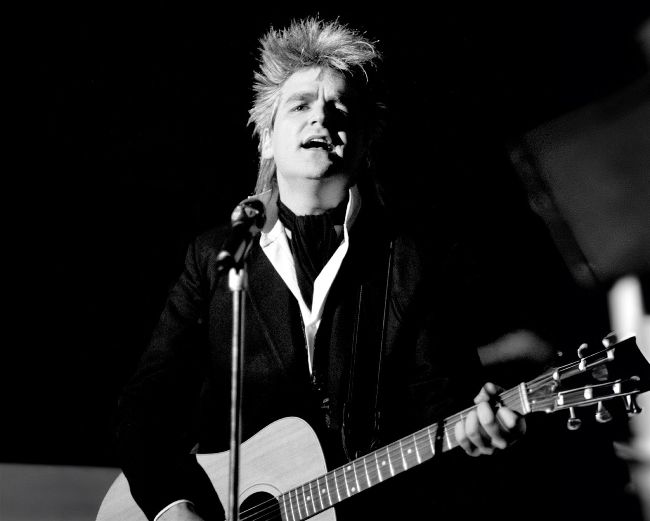
Siren’s songs: The Alarm’s Mike Peters, all power and passion in 1984.
Andre Csillag/Shutterstock
IN THE Alarm’s mid-’80s heyday, favourable reviewers would frequently use words like “heroic” and “stirring” to describe their music – adjectives that, as the decades passed, would increasingly be applied to their frontman Mike Peters, who died on April 29 after a decades-long battle with cancer. His fight against the disease was brave and unremitting, and often intertwined with newsworthy musical endeavours, most notably in 2007 when the singer and 38 other musicians trekked to the base camp of Mount Everest to perform “the highest concert ever”, raising money for his Love Hope Strength charity.
Born on February 25, 1959, Peters was raised in Rhyl, north Wales, above a pub on the corner of Henry Edward Street, a typical seaside terrace that L.S. Lowry had memorialised in a painting made in 1933. Peters’ neighbour was Eddie MacDonald, who would accompany the singer for much of the first 15 years of his musical journey, which began aged 14 after a transformative encounter with Bowie’s Aladdin Sane. It was punk, however, that would fire the singer into action; catching the Sex Pistols in Chester in September 1976, and then The Clash on the White Riot tour in Manchester – where he chatted with Joe Strummer in the urinals – Peters formed The Toilets, which by 1979 had morphed into a one-single powerpop band called Seventeen.
Rebranded as The Alarm, their fortunes changed when they were signed by U2’s agent Ian Wilson, who secured them a deal with Miles Copeland’s IRS label in 1982. Mainly an ‘acoustic’ group, by the time of their anthemic UK Top 30 singles Sixty-Eight Guns and Where Were You Hiding When The Storm Broke? they’d adopted a conventional rock sound, though Peters’ signature instrument would remain an acoustic guitar with a pick-up. February 1984’s debut album Declaration reached UK Number 6, beginning a run of moderately successful albums that failed to reflect a stellar live career that included support slots with U2, Queen and Bob Dylan. Meanwhile, a Welsh-language version of The Alarm’s 1989 LP Change demonstrated Peters’ devotion to his native culture.
THE LEGACY
The album: The Alarm – Declaration (IRS, 1984)
The sound:
Although Peters was later critical of Alan Shacklock’s production, the group’s debut contained all the vital ingredients that would suffuse the singer’s best work in the ’80s and thereafter. The rousing chord changes and martial themes of Sixty-Eight Guns and Third Light; the mystic clarion call of the title track; the spiritual, arms-aloft acoustic grandeur of We Are The Light. Power and passion, with uncanny emotional intelligence.